
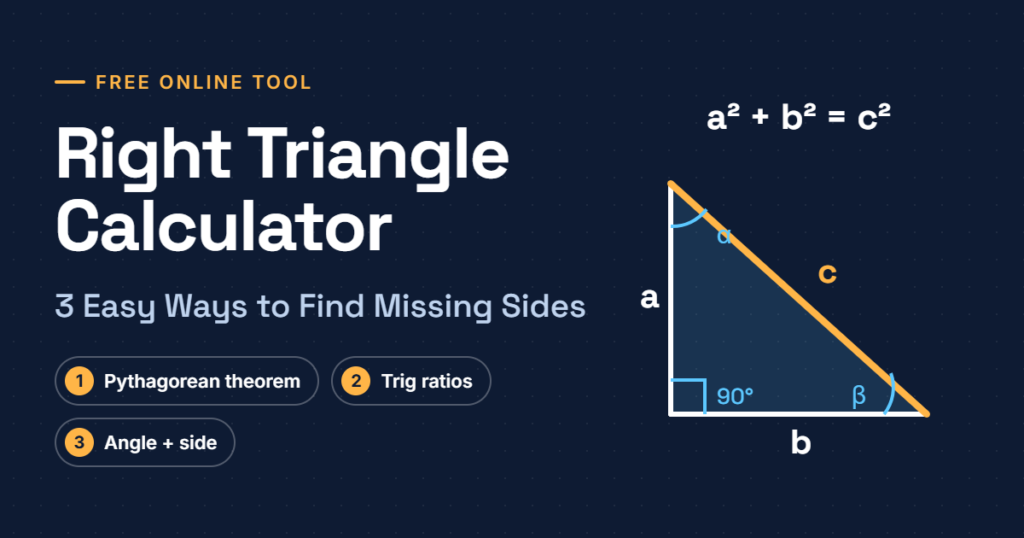
A right triangle has one 90-degree angle, and finding its missing sides or angles can sometimes be challenging. A Right Triangle Calculator makes these calculations easier by helping users determine unknown measurements using the values they already know. In this guide, readers will discover three easy ways to find missing sides, understand the Pythagorean theorem, and calculate angles using basic trigonometry. Whether someone is solving a geometry problem, measuring a construction project, or checking a mathematical result, these methods can make right triangle calculations faster and easier to understand.
What Is a Right Triangle Calculator?
A right triangle calculator is an online mathematical tool that calculates unknown sides, angles, and other measurements of a right-angled triangle. Depending on the calculator’s features, it can use two known sides, one side and an angle, or other sufficient measurements to determine the remaining values.
A right triangle contains three sides:
- Hypotenuse: The longest side, located opposite the 90-degree angle.
- Opposite side: The side directly opposite a selected acute angle.
- Adjacent side: The side next to the selected acute angle, excluding the hypotenuse.
A right-triangle calculator can help users solve geometry exercises, check homework, estimate construction measurements, and understand trigonometric relationships.
Some tools are designed as right-triangle side and angle calculators, while others also calculate area, perimeter, altitude, and circle-related measurements.
What Can a Right Triangle Calculator Find?
Depending on the available inputs, the calculator can help users:
- Find the missing hypotenuse from two legs.
- Calculate a missing leg when the hypotenuse and another leg are known.
- Determine unknown acute angles.
- Calculate the area and perimeter.
- Find the altitude to the hypotenuse.
- Determine the inradius and circumradius.
- Check whether three side lengths form a valid right triangle.
A right-angle triangle calculator can provide quick results, but understanding the underlying formulas helps users verify those results and choose the correct calculation method.
3 Easy Ways to Find Missing Sides of a Right Triangle
There are three common approaches to solving right triangle problems: applying the Pythagorean theorem, using trigonometric ratios, and working with area or other known measurements.
Method 1: Use the Pythagorean Theorem
The Pythagorean theorem is the standard method for finding a missing side when two sides of a right triangle are known.
The Pythagorean theorem formula is:
a² + b² = c²
Here:
- A represents the first leg.
- b represents the second leg.
- c represents the hypotenuse.
This relationship is the foundation of a Pythagorean theorem calculator and many hypotenuse calculator tools.
Example: Find the Hypotenuse From Two Legs
Suppose a right triangle has legs measuring 3 cm and 4 cm.
The calculation is:
c² = 3² + 4²
c² = 9 + 16
c² = 25
c = √25 = 5 cm
The hypotenuse is 5 cm.
This is a classic 3-4-5 Pythagorean triangle.
How to Find a Missing Leg
If the hypotenuse and one leg are known, the same formula can be rearranged.
To find a:
a = √(c² − b²)
To find b:
b = √(c² − a²)
For example, suppose the hypotenuse is 13 cm and one leg is 5 cm.
b = √(13² − 5²)
b = √(169 − 25)
b = √144 = 12 cm
The missing leg measures 12 cm.
These calculations cover common situations such as finding a missing leg, given a and b, find c; given a and c, find b; and given two sides, find the third.
The method also explains how to find the hypotenuse of a right triangle without measuring it directly.
Method 2: Use Trigonometric Ratios
Trigonometry in right triangles helps calculate missing sides and angles when a side and an acute angle are known.
The three main trigonometric ratios are sine, cosine, and tangent. A useful way to remember them is SOH-CAH-TOA:
- SOH: Sine = Opposite ÷ Hypotenuse
- CAH: Cosine = Adjacent ÷ Hypotenuse
- TOA: Tangent = Opposite ÷ Adjacent
The opposite and adjacent sides depend on the selected reference angle. The hypotenuse always remains opposite the right angle.
Example: Find a Side Using an Angle and the Hypotenuse
Suppose a right triangle has a hypotenuse of 10 cm and an acute angle of 30 degrees.
To find the opposite side:
sin(30°) = opposite ÷ 10
opposite = 10 × sin(30°)
opposite = 10 × 0.5
The opposite side measures 5 cm.
To find the adjacent side:
cos(30°) = adjacent ÷ 10
adjacent = 10 × cos(30°)
adjacent ≈ 8.66 cm
This approach works when the available measurements include an angle and the hypotenuse.
It can also be used when given an angle and one leg, provided the appropriate trigonometric ratio is selected.
How to Find the Missing Angle of a Right Triangle
Inverse trigonometric functions can determine an unknown acute angle when two suitable sides are known.
For an angle α:
- α = arcsin(opposite ÷ hypotenuse)
- α = arccos(adjacent ÷ hypotenuse)
- α = arctan(opposite ÷ adjacent)
The inverse cotangent function, arccot, can also be used with the ratio adjacent ÷ opposite, depending on the convention used by the calculator.
These formulas help users find the angle of a right triangle when its side lengths are known.
An angle calculator in degrees or radians may offer either unit. Degrees are commonly used in school geometry, while radians are frequently used in advanced mathematics and physics.
Method 3: Use Area and Other Known Measurements
Sometimes a triangle problem provides its area rather than two side lengths. The area formula can help determine a missing leg when one perpendicular side is known.
The area of a right triangle is:
A = ½ab
Here, a and b are the perpendicular legs.
Example: Find a Missing Side From Area
Suppose a right triangle has an area of 24 square centimeters and one leg measures 6 cm.
Using the area formula:
24 = ½ × 6 × b
24 = 3b
b = 8 cm
The missing leg is 8 cm.
The hypotenuse can then be calculated:
c = √(6² + 8²)
c = √100 = 10 cm
The triangle has side lengths of 6 cm, 8 cm, and 10 cm.
This example demonstrates how a missing side given the area can be calculated when the area and one perpendicular leg are known.
An area of a right triangle calculator can also help check the result.
However, a triangle cannot generally be solved uniquely with only one side length. A right triangle with a known hypotenuse, for example, can have different pairs of legs. Additional information, such as an acute angle or another side, is needed to determine a unique solution.
Understanding the Pythagorean Theorem and Hypotenuse Formula
The Pythagorean theorem describes the relationship between the legs and hypotenuse of every right triangle.
The hypotenuse formula is:
c = √(a² + b²)
This formula applies when the two perpendicular legs are known.
When the hypotenuse and one leg are available, the appropriate rearranged formula must be used instead.
Common Pythagorean Triples
A Pythagorean triple is a set of three positive whole numbers that satisfies the Pythagorean theorem.
Common examples include:
| First Leg | Second Leg | Hypotenuse |
|---|---|---|
| 3 | 4 | 5 |
| 5 | 12 | 13 |
| 8 | 15 | 17 |
| 7 | 24 | 25 |
| 20 | 21 | 29 |
| 6 | 8 | 10 |
| 9 | 12 | 15 |
| 9 | 40 | 41 |
For example, the 6-8-10 triangle is a scaled version of the 3-4-5 triangle. Both satisfy the same mathematical relationship.
A Pythagorean triple formula can generate additional triples using positive integers m and n, where m > n:
- First leg: m² − n²
- Second leg: 2mn
- Hypotenuse: m² + n²
When m and n are coprime and have opposite parity, the resulting triple is primitive, meaning its three numbers have no common factor greater than 1.
A Pythagorean triple generator can automate this process for users who need more examples.
How to Calculate the Angles of a Right Triangle
Every triangle has interior angles that add up to 180 degrees.
Since a right triangle contains one 90-degree angle, its two acute angles must add up to 90 degrees.
Therefore:
α + β = 90°
If one acute angle is 35 degrees, the other is:
β = 90° − 35° = 55°
An angle α and angle β calculator can determine one angle when the other is known.
When two side lengths are available, inverse trigonometric functions can be used instead.
Arcsin, Arccos, Arctan, and Arccot Formulas
These functions help calculate angles from side ratios:
- Arcsin: Finds an angle from the opposite-to-hypotenuse ratio.
- Arccos: Finds an angle from the adjacent-to-hypotenuse ratio.
- Arctan: Finds an angle from the opposite-to-adjacent ratio.
- Arccot: Finds an angle from the adjacent-to-opposite ratio, subject to the calculator’s angle convention.
The input to each inverse function must fall within its valid domain. For example, a side ratio supplied to arcsin or arccos must be between −1 and 1.
When calculating a triangle angle, the result should also be checked against the known 90-degree angle and the 90-degree sum of the two acute angles.
Area, Perimeter, and Other Right Triangle Measurements
A right triangle calculator may offer more than side and angle calculations. Additional formulas can determine the triangle’s area, perimeter, altitude, and radii.
Area of a Right Triangle
The area formula is:
A = ½ab
The two legs serve as the base and perpendicular height.
For example, a triangle with perpendicular legs of 8 cm and 6 cm has an area of:
A = ½ × 8 × 6 = 24 cm²
An area of a right triangle calculator can use the two legs to calculate the result directly.
Perimeter of a Right Triangle
The perimeter is the sum of all three sides:
P = a + b + c
For a triangle with side lengths 3 cm, 4 cm, and 5 cm:
P = 3 + 4 + 5 = 12 cm
Semiperimeter of a Right Triangle
The semiperimeter is half the perimeter:
s = (a + b + c) ÷ 2
For the same triangle:
s = (3 + 4 + 5) ÷ 2 = 6 cm
The semiperimeter is useful in other triangle formulas, including Heron’s formula for area.
Altitude or Height of a Right Triangle
An altitude is a perpendicular line drawn from a vertex to the opposite side or its extension.
The altitude to the hypotenuse is especially useful in right triangle geometry.
Its formula is:
h₍c₎ = ab ÷ c
For a triangle with legs of 3 cm and 4 cm and a hypotenuse of 5 cm:
h₍c₎ = (3 × 4) ÷ 5 = 2.4 cm
The other altitudes can be described using the corresponding side labels. In a right triangle, the two legs are perpendicular, so each leg also serves as the altitude to the other leg.
Inradius of a Right Triangle
The inradius is the radius of the circle that fits inside the triangle and touches all three sides.
For a right triangle:
r = (a + b − c) ÷ 2
For a 3-4-5 triangle:
r = (3 + 4 − 5) ÷ 2 = 1 cm
Circumradius of a Right Triangle
The circumradius is the radius of the circle passing through all three vertices.
For a right triangle:
R = c ÷ 2
For a 3-4-5 triangle:
R = 5 ÷ 2 = 2.5 cm
These measurements can be useful in geometry exercises and more advanced mathematical problems.
Special Right Triangles and Their Side Ratios
Some right triangles have predictable side ratios, making calculations easier.
The 30-60-90 Triangle
A 30-60-90 triangle has angles of 30 degrees, 60 degrees, and 90 degrees.
Its side ratio is:
1 : √3 : 2
The shortest side is opposite the 30-degree angle. The longest side, the hypotenuse, is twice the shortest side.
For example, if the shortest side is 4 cm, the other leg is 4√3 cm, and the hypotenuse is 8 cm.
The 45-45-90 Triangle
A 45-45-90 triangle has two equal acute angles and two equal legs.
Its side ratio is:
1 : 1 : √2
If each leg measures 5 cm, the hypotenuse is:
c = 5√2 ≈ 7.07 cm
This triangle is also known as an isosceles right triangle.
A special right-triangle calculator can use these standard ratios to simplify calculations when the relevant angle measurements are known.
Are All Right Triangles Similar?
No. Two right triangles are similar when their corresponding angles are equal and their corresponding sides are proportional.
All right triangles have one 90-degree angle, but their acute angles can differ. Therefore, not all right triangles are similar.
For example, a 3-4-5 triangle and a 6-8-10 triangle are similar because their corresponding sides have the same ratio.
A 3-4-5 triangle and a triangle with sides 5, 12, and 13 are not similar because their corresponding side ratios differ.
Can a Right Triangle Have Equal Sides?
Yes. A right triangle can have two equal sides, but not three equal sides.
An isosceles right triangle has two equal legs and two equal acute angles of 45 degrees. Its side ratio is 1:1:√2.
The hypotenuse is always longer than either leg, so all three sides cannot be equal.
Lines of Symmetry of a Right Triangle
A scalene right triangle has no lines of symmetry because all three sides differ in length.
An isosceles right triangle has one line of symmetry. This line runs from the right-angle vertex to the midpoint of the hypotenuse.
Real-World Uses of Right Triangle Calculations
Right triangle calculations are useful in construction, engineering, navigation, physics, and everyday measuring tasks.
Brace Length for Squaring a Frame
Builders can use the 3-4-5 carpenter trick to check whether two sides of a frame meet at a right angle.
If one side measures 3 units and the other measures 4 units, the diagonal should measure 5 units.
The 6-8-10 version uses the same ratio at a larger scale. These measurements help verify a square corner before the frame is secured.
For larger layouts, the 5-12-13 combination can also be used for squaring a corner.
Ramp Slope and Rise/Run Calculations
A ramp can be modeled as a right triangle when its vertical rise, horizontal run, and sloping length are measured.
The slope is calculated as:
Slope = Rise ÷ Run
To express it as a percentage:
Slope percentage = (Rise ÷ Run) × 100
The Pythagorean theorem can determine the sloping length when the rise and run are known.
A ramp slope and rise/run calculator can help with preliminary measurements, although accessibility and building requirements must be checked separately.
Rafter and Gable Roof Length
Roof framing often involves right triangles. The horizontal distance from a wall to the roof’s peak projection and the vertical rise can be used to calculate the rafter length.
The calculation is:
Rafter length = √(Run² + Rise²)
Actual construction measurements may also require allowances for overhangs, cuts, and roof design.
Surveying, Navigation, and Physics
Right triangle formulas are also useful for surveying line-of-sight measurements and slope distance calculations.
In navigation, geometric models can estimate the distance to the horizon when the relevant assumptions about height and the Earth’s radius are specified.
In physics, vector decomposition separates a vector into perpendicular components. Projectile motion can also use horizontal and vertical components to analyze displacement and range under appropriate assumptions.
For three-dimensional measurements, the 3D Pythagorean theorem can calculate the space diagonal of a rectangular box:
d = √(l² + w² + h²)
Here, l, w, and h represent the box’s length, width, and height.
How to Use a Right Triangle Calculator
A right triangle calculator is generally straightforward to use. The exact steps depend on the tool’s design and the information it accepts.
- Choose the known measurements. Identify the sides or angles provided in the problem.
- Enter the values. Supply the measurements in the appropriate fields and use consistent units.
- Select the calculation method. Choose the required side, angle, or measurement if the calculator offers different modes.
- Calculate the result. Run the calculation to obtain the missing values.
- Check the result. Verify that the side lengths satisfy the Pythagorean theorem and that the angles are consistent with a right triangle.
For example, a user who knows both legs can use the Pythagorean theorem to find the hypotenuse. Someone who knows a leg and an acute angle can use an appropriate trigonometric ratio.
If only one side is known, additional information is needed to determine a unique triangle.
Choosing the Right Calculator for the Problem
Different calculators serve different purposes:
- A hypotenuse calculator focuses on calculating the longest side from the two legs.
- A trigonometry calculator handles trigonometric ratios and angles.
- A triangle area calculator focuses on finding the area.
- A general triangle calculator may handle SSS, SAS, ASA, AAS, or AAA inputs, depending on the tool’s capabilities.
Other tools, such as an isosceles triangle calculator, equilateral triangle calculator, law of sines calculator, and law of cosines calculator, address different triangle types or calculation methods.
A law of sines calculator or law of cosines calculator may be appropriate for non-right triangles. A right triangle can also be solved using the law of sines, but the Pythagorean theorem and basic trigonometric ratios are often more direct.
Frequently Asked Questions
1. What is a right triangle calculator used for?
A right triangle calculator helps determine unknown side lengths, acute angles, area, perimeter, and other measurements of a right triangle when sufficient information is available.
2. How can someone find the missing side of a right triangle?
When two legs are known, the hypotenuse is calculated using c = √(a² + b²). When the hypotenuse and one leg are known, the missing leg is calculated by subtracting the square of the known leg from the square of the hypotenuse and taking the square root.
3. How can someone find a missing angle?
An unknown acute angle can be calculated using arcsin, arccos, or arctan, depending on which side lengths are known. The two acute angles also add up to 90 degrees.
4. Can a right triangle be solved with only one side?
Not uniquely in general. A single side length does not determine the triangle’s shape. Another side, an acute angle, or other sufficient information is needed.
5. What is the Pythagorean theorem?
The Pythagorean theorem states that the sum of the squares of the two legs equals the square of the hypotenuse: a² + b² = c².
6. What is the difference between a right triangle and a special right triangle?
A right triangle has one 90-degree angle. Special right triangles, such as 30-60-90 and 45-45-90 triangles, also have fixed angle relationships and predictable side ratios.
Conclusion
A Right Triangle Calculator makes it easier to determine missing sides, calculate acute angles, and check measurements. The Pythagorean theorem is useful when two sides are known, trigonometric ratios help when angles and sides are available, and the area formula can reveal a missing leg when the area and another perpendicular side are known.
Understanding these three methods helps students, builders, and other users choose the right formula for each problem. With the correct measurements and a reliable calculation method, right triangle problems become easier to solve and verify.