

Planning a landscaping, gardening, construction, or home improvement project often starts with one important question: how much material is actually needed? Ordering too little soil, mulch, gravel, sand, or another material can create delays, while ordering too much can increase costs and leave unnecessary material behind.
A cubic yard calculator can make this estimation much easier. By using the length, width, and depth of an area, it can help determine the approximate volume of material required. Understanding the basic calculation also allows homeowners, gardeners, contractors, and DIY project planners to check their estimates before placing an order.
What Is a Cubic Yard?
A cubic yard is a unit used to measure volume. It represents a space that is one yard long, one yard wide, and one yard deep.
Because one yard equals three feet, one cubic yard contains:
3 feet × 3 feet × 3 feet = 27 cubic feet
Therefore:
1 cubic yard = 27 cubic feet
Cubic yards are commonly used when buying materials that are delivered in bulk. Landscaping suppliers, garden centers, and construction companies often sell materials such as topsoil, mulch, gravel, sand, and stone by the cubic yard.
It is important to remember that a cubic yard measures volume rather than weight. A cubic yard of gravel, for example, will weigh considerably more than a cubic yard of mulch because the materials have different densities.
Why Accurate Material Estimates Matter
An accurate material estimate can make a project easier to plan and budget. Material costs can become significant when a project covers a large area, so a reliable volume calculation can help prevent unnecessary purchases.
Ordering too little material may require another delivery, which can add transportation costs and delay the project. Ordering too much may leave excess material that needs to be stored, moved, or disposed of.
A reasonable estimate also helps with comparing supplier prices. If one supplier quotes a price per cubic yard and another uses a different measurement, knowing the required volume makes the comparison simpler.
How to Calculate Cubic Yards
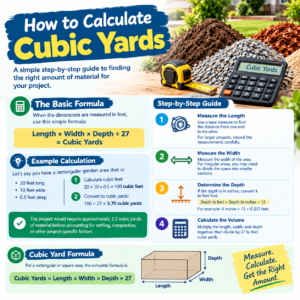
The basic cubic yard calculation is straightforward when the dimensions are measured in feet.
The standard formula is:
Length × Width × Depth ÷ 27 = Cubic Yards
For example, consider a rectangular garden area that is:
- 20 feet long
- 10 feet wide
- 0.5 feet deep
The volume calculation would be:
20 × 10 × 0.5 = 100 cubic feet
The cubic feet are then converted into cubic yards:
100 ÷ 27 = 3.70 cubic yards
The project would therefore require approximately 3.7 cubic yards of material before accounting for settling, compaction, or other project-specific factors.
Step 1: Measure the Length
The first measurement is the length of the area. A tape measure can be used to determine the distance from one end to the other.
For larger projects, measurements should be recorded carefully rather than estimated visually.
Step 2: Measure the Width
Next, the width of the area should be measured. For a rectangular space, the length and width are usually easy to identify.
For irregular areas, the space may need to be divided into smaller sections.
Step 3: Determine the Depth
Depth is particularly important because even a small change in depth can significantly affect the amount of material required.
For example, a mulch bed that is two inches deep requires less material than the same area covered to four inches.
If the depth is provided in inches, it should first be converted into feet:
Depth in feet = Depth in inches ÷ 12
For example:
4 inches ÷ 12 = 0.333 feet
That converted measurement can then be used in the cubic yard formula.
Step 4: Calculate the Volume
Once the length, width, and depth are known, they are multiplied together.
Length × Width × Depth = Cubic Feet
The resulting cubic feet are divided by 27 to determine cubic yards.
Cubic Yard Formula
For a rectangular or square area, the complete formula is:
Cubic Yards = Length × Width × Depth ÷ 27
All three measurements should be expressed in feet before the calculation is performed.
When dimensions are measured in inches, another useful formula is:
Length × Width × Depth ÷ 46,656 = Cubic Yards
The number 46,656 comes from converting cubic inches into cubic yards.
Using a consistent measurement system helps reduce calculation errors.
How a Cubic Yard Calculator Works
A cubic yard calculator automates the mathematical steps involved in estimating material volume.
Typically, the user enters:
- Length
- Width
- Depth
- Measurement units
The calculator then determines the approximate volume and converts the result into cubic yards.
This can be especially helpful when several calculations need to be performed. Instead of repeatedly multiplying measurements and dividing by 27, the calculator can provide a result almost immediately.
However, the calculator is only as accurate as the measurements entered into it. Incorrect dimensions can produce an incorrect material estimate.
Examples of Common Materials
The same volume calculation can be used for many bulk materials. The difference is usually in how much material is needed for a particular project and how the material behaves after installation.
Soil
Garden beds, raised beds, and lawn projects often require topsoil or garden soil.
For example, a rectangular garden measuring 15 feet by 8 feet with a depth of 6 inches would first have the depth converted to feet:
6 ÷ 12 = 0.5 feet
The calculation becomes:
15 × 8 × 0.5 ÷ 27 = 2.22 cubic yards
The final order may need to be adjusted depending on the type of soil and whether it is expected to settle.
Mulch
Mulch is commonly measured by volume when covering flower beds and landscaped areas.
Since mulch can settle after installation, the desired finished depth should be considered when estimating the quantity.
A calculator can help compare different depths, such as two, three, or four inches, before an order is placed.
Gravel
Gravel is frequently used for driveways, pathways, drainage areas, and landscaping.
A gravel project should be measured carefully because the required depth can vary across the site. Uneven ground may also make the average depth more useful than measuring only one location.
Sand
Sand may be required for construction, paving, landscaping, playground areas, and other projects.
The required volume depends on the dimensions and intended depth. Since sand can shift and settle, the final quantity should be reviewed according to the project’s specific requirements.
Concrete
Concrete calculations require additional care. Although volume can be calculated in cubic yards, actual concrete orders may need to account for forms, reinforcement, uneven ground, waste, and delivery requirements.
For structural or large-scale concrete work, professional confirmation is recommended before ordering.
How to Measure Irregular Areas
Not every project has a simple rectangular shape. Garden beds, yards, pathways, and landscaping areas can have curves, angles, or unusual boundaries.
One practical approach is to divide the area into smaller sections.
For example, an irregular garden might be divided into three rectangles. Each section can be calculated separately:
Section 1 + Section 2 + Section 3 = Total Volume
The total cubic feet can then be divided by 27.
For circular areas, the area can be calculated using:
Area = π × radius²
The area is then multiplied by the depth to find cubic feet. Dividing that volume by 27 converts it to cubic yards.
Breaking a complicated project into smaller, manageable sections often produces a more reliable estimate.
How Much Material Should Be Ordered?
The calculated number represents the estimated volume based on the measurements provided. It does not always represent the exact amount that should be ordered.
Several factors can influence the final quantity, including:
- Material settling
- Soil compaction
- Uneven ground
- Installation depth
- Material loss during installation
- Project waste
- Changes in site conditions
For this reason, project planners should consider the characteristics of the material and the recommendations of the supplier or contractor.
A small landscaping project may require a different approach from a large construction project. There is no single extra amount that works for every situation.
Common Mistakes to Avoid
Forgetting to Convert Inches to Feet
One of the most common errors is entering a depth in inches while using length and width in feet.
A depth of four inches is not the same as four feet. Converting measurements before calculating is essential.
Using the Wrong Depth
The depth has a direct effect on volume. A project designed for three inches of material will require a different amount than one designed for six inches.
Several depth measurements may be useful when the ground is uneven.
Confusing Square Feet With Cubic Yards
Square feet measure area, while cubic yards measure volume.
A surface area alone does not tell how much material is required. Depth must also be included.
Ignoring Irregular Shapes
Treating an irregular space as a perfect rectangle can lead to an inaccurate estimate.
Dividing the area into smaller sections can provide a better result.
Assuming Every Material Weighs the Same
One cubic yard always contains the same volume, but different materials can have very different weights.
This matters when considering delivery vehicles, hauling capacity, and supplier recommendations.
When a Cubic Yard Calculator Is Most Useful
A cubic yard calculator can be useful for a wide range of projects, including:
- Garden bed preparation
- Mulch installation
- Lawn renovation
- Gravel pathways
- Driveway projects
- Drainage work
- Sand applications
- Topsoil delivery
- Raised garden beds
- Construction projects
It can also be useful during the planning stage when comparing different material depths.
For example, a homeowner planning a flower bed could calculate the quantity needed at two inches, three inches, and four inches. Comparing those results can make budgeting and material selection easier.
Tips for Getting a More Reliable Estimate
Accurate measurements are the foundation of a good material estimate. A few simple habits can improve the result.
First, measurements should be taken more than once when accuracy matters. Second, measurements should be written down immediately to avoid mixing up numbers. Third, all dimensions should be converted to the same unit before the calculation begins.
For larger areas, dividing the site into sections can make the calculation easier and reduce mistakes.
It is also useful to check the calculator result against the supplier’s recommended quantity. Suppliers may have additional guidance based on material type, compaction, delivery practices, and installation requirements.
Final Thoughts
Calculating material quantities does not have to be complicated. Once the length, width, and depth of an area are known, the basic cubic yard formula can provide a useful estimate.
A cubic yard calculator makes the process even simpler by performing the calculations automatically and reducing the amount of manual math involved. It can help estimate the amount of soil, mulch, gravel, sand, and other bulk materials required for landscaping, gardening, construction, and home improvement projects.
The key is to start with accurate measurements and use the correct depth. For irregular areas or projects where material quantities have high cost or structural consequences, additional professional or supplier guidance can provide greater confidence before an order is placed.
Frequently Asked Questions
How many cubic feet are in one cubic yard?
One cubic yard contains 27 cubic feet.
How do you calculate cubic yards from feet?
Multiply the length, width, and depth in feet. Then divide the result by 27.
Length × Width × Depth ÷ 27 = Cubic Yards
Can a cubic yard calculator be used for soil and mulch?
Yes. A cubic yard calculator can estimate the volume required for materials such as soil, mulch, gravel, sand, and other bulk products when the project’s dimensions are known.
Does one cubic yard always weigh the same?
No. A cubic yard measures volume, not weight. Different materials have different densities, so their weights can vary considerably.
How can an irregular area be calculated?
An irregular area can usually be divided into smaller rectangles, squares, circles, or other measurable sections. The individual volumes can then be added together to estimate the total requirement.
Should extra material always be ordered?
Not necessarily. The appropriate quantity depends on the material, project conditions, compaction, settling, waste, and supplier recommendations. The calculated volume should be treated as an estimate rather than a guarantee of the exact amount required.