
Introduction
Waiting to find out whether school will be canceled because of heavy snow can be frustrating for students, parents, and teachers. Uncertain weather forecasts make it difficult for families to plan ahead, especially during winter storms. That’s where a Snow Day Calculator comes in handy. It helps estimate the likelihood of school closures by considering snowfall, temperature, road conditions, and other weather factors. In this guide, readers will discover three easy ways to predict school closures, understand what affects snow day decisions, and learn how to estimate whether tomorrow could be a snow day.
What Is a Snow Day Calculator?
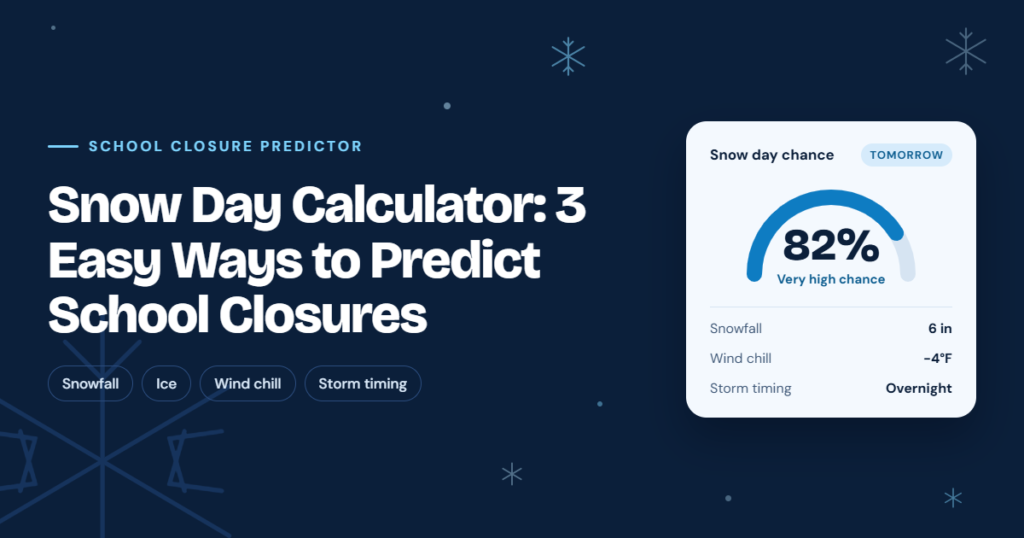
A snow day calculator is an online weather tool that estimates the possibility of school closures during winter weather. It analyzes weather conditions and other relevant factors to help students and parents understand whether their school district might cancel classes.
Unlike a regular weather calculator that focuses mainly on temperature or precipitation, a snow day predictor considers conditions that can affect school transportation and student safety.
For example, a forecast showing several inches of overnight snow, freezing rain, or extremely low temperatures may increase the likelihood of a school closure. However, the final decision depends on local conditions and the school district’s inclement weather policy.
A typical snow day calculator may consider:
- Expected snowfall and snow accumulation.
- Ice accumulation and freezing rain.
- Temperature and wind chill.
- Storm timing and intensity.
- Road conditions and visibility.
- Local weather forecasts.
- Historical closure data.
- School district location and policies.
A free snow day calculator can provide a convenient starting point for estimating school closure probability without requiring families to analyze multiple weather reports manually.
3 Easy Ways to Predict School Closures
There are three practical ways to estimate whether students might receive a snow day. Each method provides a different perspective, from using an online calculator to reviewing official weather information.
1. Use a Snow Day Calculator by Location
The easiest way to estimate a possible school closure is to use a snow day calculator by location. These tools allow users to enter information about their area and receive an estimated snow day probability.
Depending on the tool, the user may need to provide:
- ZIP code or postal code.
- City or school district.
- Current location or coordinates.
- Expected snowfall.
- Local temperature.
- Weather forecast information.
After receiving the location details, a snow day predictor can evaluate relevant weather conditions and produce an estimated probability.
For example, a school district expecting heavy snowfall overnight may have a greater chance of closing than a district expecting only light snow. Similarly, a rural district with difficult road access may face different transportation challenges than an urban district with well-maintained roads.
A real snow day calculator should make its estimation process understandable and explain that its results are not official school announcements.
Why location matters
Weather conditions can vary significantly between nearby communities. A snow day calculator in Buffalo may produce a different estimate from a snow day calculator in Toronto because the two locations have different weather patterns, road systems, and school policies.
The same applies to searches such as:
- Snow day calculator Chicago.
- Snow day calculator London.
- Snow day calculator Boston.
- Snow day calculator Minneapolis.
- Snow day calculator Denver.
- Snow day calculator Detroit.
- Snow day calculator Cleveland.
- Snow day calculator Pittsburgh.
- Snow day calculator Philadelphia.
- Snow day calculator New York.
- Snow day calculator Rochester.
- Snow day calculator Syracuse.
- Snow day calculator Columbus.
- Snow day calculator Indianapolis.
- Snow day calculator Milwaukee.
- Snow day calculator Salt Lake City.
- Snow day calculator Baltimore.
- Snow day calculator Washington.
- Snow day calculator Anchorage.
- Snow day calculator Montreal.
- Snow day calculator Ottawa.
- Snow day calculator Calgary.
- Snow day calculator Manchester.
- Snow day calculator Birmingham.
- Snow day calculator Edinburgh.
These location-based searches demonstrate why a single national snow day estimate cannot accurately represent every school district.
2. Check Weather Forecasts and Snowfall Predictions
Another useful method is to review local weather forecasts before estimating the possibility of school closures.
A snow day prediction becomes more meaningful when it considers the timing, intensity, and expected accumulation of winter precipitation rather than snowfall totals alone.
Several weather factors deserve attention.
Expected snowfall and snow accumulation
Snowfall amount is one of the most important considerations. However, there is no universal measurement that guarantees a school closure.
A few inches of snow might create serious transportation problems in an area that rarely receives winter weather. Meanwhile, a community accustomed to heavy snowfall may continue operating schools under similar conditions.
This explains why questions such as “how much snow does it take to get a snow day?” and “how much snow closes school?” do not have one answer.
Ice accumulation and freezing rain
Freezing rain can create dangerous road conditions even when snowfall is limited. A thin layer of ice can make roads, sidewalks, and school entrances slippery.
Sleet and mixed precipitation can also complicate travel, particularly when temperatures fluctuate around freezing.
In some situations, an ice storm may create a greater school closure risk than ordinary snowfall.
Temperature and wind chill
Temperature affects snow and ice conditions, but extreme cold can also create safety concerns independently of snowfall.
Wind chill measures how cold conditions feel when wind affects exposed skin. It is particularly important when students must wait for buses or walk to school.
However, does wind chill alone close schools? That depends on district policy and local safety guidelines.
Storm timing and morning commute
The timing of a winter storm can be just as important as its total snowfall.
For example, a storm arriving late at night may leave several inches of overnight snow on roads before the morning commute. A pre-dawn storm can create similar problems by reducing the time available for road treatment and snow removal.
Weather forecasts should therefore include:
- Hourly forecast information.
- 24-hour forecast updates.
- 5-day forecast trends.
- 7-day forecast outlooks.
- Wind speed and wind gusts.
- Visibility and black ice risks.
- Snow rate and storm intensity.
- Blizzard warnings and extreme cold alerts.
Humidity and atmospheric pressure may also help describe changing weather conditions, although they are not direct indicators of school closure decisions.
Why official weather information matters
Weather information from trusted organizations can help families understand local winter conditions.
Useful sources include:
- NOAA (National Oceanic and Atmospheric Administration).
- NWS (National Weather Service).
- weather.gov.
- Open-Meteo.
- Environment Canada.
- UK Met Office.
The Winter Storm Severity Index (WSSI) can also help communicate the potential impacts of winter weather in the United States.
These sources provide valuable weather intelligence, but they do not make school closure decisions.
3. Check School District Policies and Official Announcements
The third method is to review the school’s official communication channels and understand its winter weather policy.
Even an accurate snow day prediction cannot replace an announcement from the superintendent or school district.
School administrators consider several factors before deciding whether students should attend classes.
These may include:
- Road safety and snow removal progress.
- School bus routes and transportation availability.
- Weather warnings and forecast changes.
- Conditions around school buildings.
- Student and staff safety.
- Local emergency guidance.
- District policies and available resources.
A school district may choose between a complete closure, delayed opening, early dismissal, or a remote learning day.
When do schools announce snow days?
Many school districts communicate closure decisions during the evening before a storm or early in the morning. The timing depends on weather developments and the amount of preparation required.
Families can check:
- Official school district websites.
- School email notifications.
- Text message alerts.
- Local television and radio stations.
- Verified social media accounts.
- School transportation announcements.
Checking these sources is the best way to determine whether there will be a snow day tomorrow, whether school will be closed tomorrow, or whether classes will be canceled tomorrow.
A calculator can estimate the possibility, but only the appropriate school authority can confirm the decision.
How Does a Snow Day Calculator Work?
Understanding how a snow day calculator works helps users interpret its results more realistically.
Most calculators follow a process that combines location information, weather conditions, and a prediction method to estimate school closure probability.
Although different tools use different approaches, a typical process involves the following steps.
Step 1: Collect Location and Weather Information
The calculator begins by collecting location details, such as a ZIP code, postal code, city, or coordinates.
Some tools may also provide a use my current location option to simplify the process.
Location information helps identify the relevant weather forecast and regional conditions.
Step 2: Analyze Important Weather Factors
The tool evaluates conditions such as snowfall, ice accumulation, temperature, wind chill, and storm timing.
A more advanced weather calculator may use real-time weather data to update its estimates as forecasts change.
Step 3: Generate a Probability Estimate
The algorithm combines the available information to calculate a snow day probability.
For example, it might produce an estimated 75% chance of school closure.
This does not mean the school is guaranteed to close. It means the calculator’s model considers the available conditions favorable to a possible closure.
Some advanced systems may use machine learning, historical closure data, and regional resilience coefficients to improve their predictions.
However, the actual quality depends on the data, methodology, and local information available to the calculator.
Understanding Snow Day Probability
Snow day probability represents an estimate of how likely a school closure may be under the predicted weather conditions.
A calculator may display its results as a percentage, making it easier for families to understand the estimated risk.
The following ranges offer a simple way to interpret probability results.
| Snow Day Probability | Possible Interpretation |
|---|---|
| 0–29% | Low possibility of school closure |
| 30–59% | Moderate possibility |
| 60–79% | High possibility |
| 80–100% | Very high possibility |
These ranges are general interpretation guidelines, not official school district thresholds.
For example, a 70% chance of a snow day does not mean school will definitely close. The actual decision may depend on road conditions, storm timing, bus safety, and local policies.
Snow day probability vs. chance of snow
These two measurements are different.
The chance of snow describes the likelihood of precipitation occurring in a particular area. Snow day probability estimates the possibility of school closure.
A forecast showing a 70% chance of snow does not automatically translate into a 70% probability of school cancellation.
Similarly, a snow day prediction vs. weather forecast comparison reveals an important distinction: a weather forecast describes atmospheric conditions, while a school closure prediction estimates how those conditions might affect school operations.
How Much Snow Does It Take to Get a Snow Day?
There is no fixed snowfall amount that automatically closes every school.
The required conditions vary depending on regional weather patterns, road maintenance, school transportation, and local safety requirements.
For instance, a community in Minnesota or Wisconsin may have better preparation for regular snowfall than a community in Georgia or Tennessee.
Consider these general examples:
- Light snowfall: Schools may remain open if roads are safe and transportation continues normally.
- Moderate snowfall: A delayed opening may be considered if road conditions deteriorate.
- Heavy snowfall: A school closure becomes more likely when roads and bus routes become unsafe.
- Freezing rain: Ice accumulation may lead to closures even without significant snowfall.
- Extreme cold: Schools may close if outdoor conditions create safety concerns.
Is 1/2 Inch of Snow Enough for a Snow Day?
Half an inch of snow is not normally enough to guarantee a snow day. However, the impact depends on local conditions.
If the snowfall combines with freezing rain, black ice, or unusually cold temperatures, even a small amount of precipitation may create dangerous travel conditions.
Is 20 Degrees Cold Enough to Snow?
Snow can fall when the temperature is around 20°F, provided the atmospheric conditions support snow formation.
However, temperature alone does not determine whether school will close. The condition of roads, sidewalks, bus routes, and outdoor areas matters more when school administrators make their decisions.
Can There Be a Snow Day Without Snow?
Yes. A school can close without snowfall if another weather-related hazard creates unsafe conditions.
Examples include:
- Dangerous freezing rain.
- Extreme cold.
- Severe ice accumulation.
- Blizzard conditions from blowing snow.
- Unsafe roads caused by previous storms.
This is why the terms cold day and ice day are sometimes used alongside traditional snow day announcements.
Why Do Nearby Schools Have Different Snow Day Decisions?
It can seem confusing when one school closes while another nearby school remains open.
However, school districts do not always experience identical transportation and safety conditions.
Several factors can explain these differences.
1. Different road conditions
One district may have treated roads and effective snow removal, while another may still have dangerous snow accumulation.
2. Different bus routes
Rural districts often have longer bus routes and may travel through less-maintained roads. Urban districts may have different transportation challenges, including traffic and congestion.
3. Different school policies
Each school district establishes its own inclement weather policy. Some administrators may take a more cautious approach, while others may continue operating when conditions are manageable.
4. Different weather patterns
Snowfall can vary across short distances, especially in regions affected by lake-effect snow.
For example, weather conditions in Buffalo may differ from those in nearby communities, even during the same winter storm.
A comparison such as Atlanta vs. Buffalo also demonstrates why regional weather experience matters when evaluating winter weather risks.
Different Types of School Closures and Delays
Not every winter weather announcement means students receive a full day off.
School districts may use several types of schedule changes depending on the severity of the conditions.
Snow Day or Emergency Closure
A snow day generally means school buildings are closed and normal in-person classes are canceled.
An emergency closure may also occur because of severe weather or other safety concerns.
2-Hour Delay or Delayed Opening
A 2-hour delay means schools open later than their normal schedule.
This gives road crews additional time to clear snow, treat icy roads, and improve transportation safety.
Students and parents should check the official schedule because bus pickup and school start times may change.
Early Dismissal
An early dismissal happens when students leave school before the normal closing time.
School administrators may use this option when dangerous weather is expected to develop later in the day.
Virtual Snow Day or Remote Learning Day
Some school districts use a virtual snow day instead of canceling educational activities entirely.
Students attend classes remotely or complete assigned work from home.
This arrangement is often called a remote learning day.
Cold Day and Ice Day
A cold day refers to a closure caused primarily by dangerously low temperatures.
An ice day usually refers to a school cancellation because freezing rain, black ice, or other icy conditions make transportation unsafe.
Calamity Days and Make-Up Days
Some school systems use the term calamity days for closures caused by emergencies or severe weather.
Depending on state laws and district policies, schools may have a limited number of closure days before additional instructional time or make-up days become necessary.
Is the Snow Day Calculator Real and Accurate?
A common question among students and parents is whether the snow day calculator is real, legit, and accurate.
The answer depends on the calculator’s data sources and prediction methodology.
A calculator that uses reliable weather information, relevant location details, and reasonable assumptions can provide a useful estimate.
However, no calculator can guarantee a school closure because the final decision belongs to school administrators.
How Accurate Is the Snow Day Calculator?
Accuracy depends on several factors:
- Quality of weather information.
- Accuracy of snowfall predictions.
- Local road conditions.
- Availability of historical closure data.
- Regional weather patterns.
- School district decision-making practices.
An accurate snow day calculator should clearly explain its limitations rather than presenting every prediction as a confirmed result.
A calculator using only a general weather forecast may provide less meaningful estimates than one that considers local transportation and district conditions.
Snow Day Predictor vs. Calculator
A snow day predictor and a snow day calculator often describe similar tools.
A predictor generally emphasizes forecasting the possibility of a school closure, while a calculator may allow users to enter specific information and receive a numerical probability.
The names do not necessarily indicate different levels of accuracy. The underlying methodology is more important.
Why Does the Calculator Cap at 95%?
Some calculators limit their maximum prediction to 95% instead of displaying 100%.
This can be a way to communicate uncertainty and avoid presenting an estimate as a guarantee.
Weather forecasts can change, roads may improve unexpectedly, and school administrators may make decisions based on information unavailable to the calculator.
A probability cap is a design choice, not a universal requirement for every snow day prediction tool.
What Is the 4-4-4 Blizzard Rule?
The 4-4-4 blizzard rule is sometimes discussed in online winter weather conversations as a way to describe severe snowfall and dangerous winter conditions.
However, it is not a universal school closure standard or an official rule that determines whether classes must be canceled.
Blizzard warnings and official weather alerts should always take priority over informal internet rules.
School administrators consider local conditions and safety guidance rather than relying on a single numerical formula.
What Is the Trick for Getting a Snow Day?
Students sometimes share playful snow day tricks when hoping for a day off from school.
Popular traditions include:
- Putting a spoon under a pillow.
- Placing an ice cube outside.
- Wearing pajamas inside out.
- Sleeping with a spoon under the bed.
- Performing other snow day rituals.
These traditions are entertaining, but they do not influence weather conditions or school administrators’ decisions.
A more practical approach is to monitor local forecasts, check official announcements, and prepare for changing winter weather.
How to Calculate Snowfall Manually
A manual snow day calculator can help users understand snowfall estimates without relying entirely on an online tool.
One simple method involves measuring accumulated snow over a known period.
For example, if a location receives approximately 3 inches of snow over 6 hours, the average snowfall rate can be calculated as follows:
Average Snowfall Rate = Total Snowfall ÷ Number of Hours
Using the example:
3 ÷ 6 = 0.5 inches per hour.
This provides a basic estimate of snowfall intensity.
However, actual snow accumulation can vary because of wind, melting, compaction, and changing precipitation rates.
A manual calculation cannot independently determine whether a school will close. It should be combined with weather information and local district policies.
What Makes a Good Snow Day Calculator in 2026?
A useful snow day calculator for 2026 should offer more than a basic snowfall estimate.
It should provide understandable results, use reliable weather information, and make it easy for users to check conditions in their area.
Important features include:
Location-based predictions: The tool should support ZIP code, postal code, city, or coordinates to provide relevant local estimates.
Updated weather information: Access to current forecasts helps the calculator respond to changing conditions.
Multiple weather factors: Snowfall, freezing rain, wind chill, temperature, and storm timing should be considered where relevant.
Simple probability results: A percentage makes predictions easier to understand.
Transparent methodology: Users should be able to understand which factors influence the result.
Mobile-friendly design: Students and parents should be able to check predictions from smartphones, tablets, and desktop computers.
Clear limitations: The calculator should explain that its prediction is not an official school announcement.
A reliable winter weather tool should help families prepare rather than promise an outcome that cannot be guaranteed.
Frequently Asked Questions About Snow Day Calculators
1. Will There Be a Snow Day Tomorrow?
A snow day may be possible if local forecasts show heavy snowfall, freezing rain, extreme cold, or unsafe road conditions. A snow day calculator can estimate the possibility, but the official school district announcement confirms whether classes are canceled.
2. Will School Be Closed Tomorrow?
School closures depend on weather conditions, transportation safety, and district policies. Families should check their school’s official website, email notifications, or local announcements for confirmation.
3. How Does a Snow Day Calculator Work?
A snow day calculator evaluates location information and relevant weather conditions, such as expected snowfall, temperature, ice accumulation, and storm timing. It then generates an estimated probability of school closure.
4. Is the Snow Day Calculator Legit?
A snow day calculator can be a legitimate forecasting tool when it uses reliable information and explains its methodology. However, its results are estimates rather than official closure decisions.
5. Can Freezing Rain Cause a Snow Day?
Yes. Freezing rain can create dangerous ice on roads, sidewalks, and bus routes. School districts may close schools even when little or no snow has accumulated.
6. Who Decides If It’s a Snow Day?
The school district, superintendent, or designated school administrators generally make the final decision. They consider weather forecasts, road conditions, transportation safety, and local policies.
7. Is School Open Tomorrow If the Snow Day Probability Is 70%?
A 70% probability indicates a relatively high estimated chance of closure, but it does not confirm that school will be canceled. Students and parents should wait for an official announcement.
8. What Is a 2-Hour Delay?
A 2-hour delay means the school day begins two hours later than usual. It allows additional time for snow removal, road treatment, and safer transportation.
9. Can Extreme Cold Cause a School Closure Without Snow?
Yes. Extremely low temperatures and dangerous wind chill can create health and transportation risks. Some districts have specific cold-weather closure policies.
10. What Is the Difference Between a Snow Day and an Ice Day?
A snow day usually involves significant snowfall or snow-related travel hazards. An ice day refers to a closure caused primarily by freezing rain, black ice, or dangerous icy conditions.
Final Thoughts
A Snow Day Calculator can make winter weather planning easier by helping students, parents, and teachers estimate the possibility of school closures. By combining location-based predictions, weather forecasts, and school district policies, families can make more informed decisions before a winter storm arrives.
The three methods discussed in this guide offer a practical starting point: use an online calculator, review local weather conditions, and monitor official school announcements. Whether the forecast predicts heavy snowfall, freezing rain, or extreme cold, preparation is always more useful than relying on guesswork.
Although a snow day predictor can offer valuable insights, it cannot guarantee a day off. The final decision always rests with the school district and the safety conditions in the local community.