
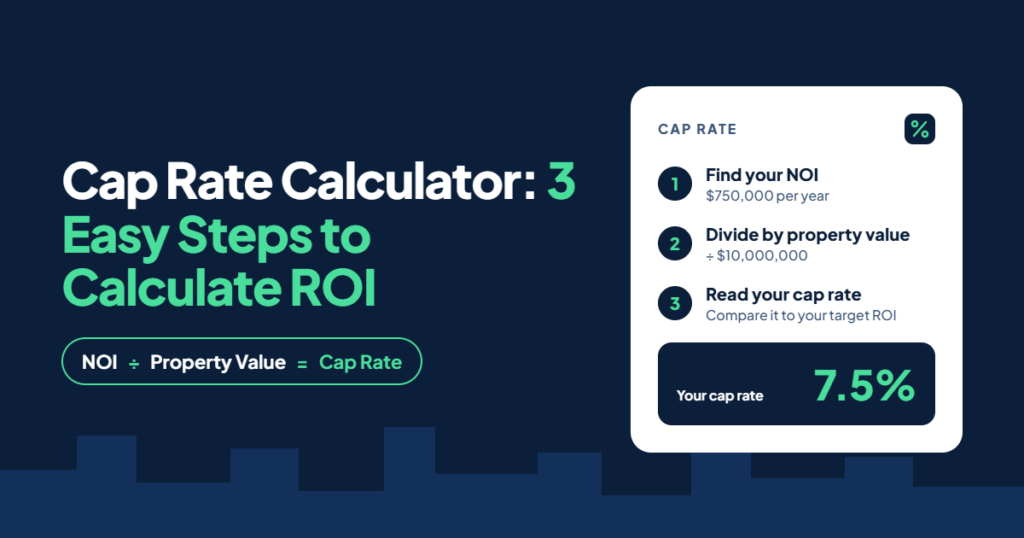
Real estate investors need more than an attractive purchase price to identify a profitable investment. They also need to understand how much income a property generates compared with its market value. A Cap Rate Calculator simplifies this process by estimating the capitalization rate using a property’s net operating income and value. This percentage helps investors compare rental properties, evaluate potential cash flow, and assess investment opportunities before making a purchase.
Whether an investor is considering a single-family rental, an apartment building, or a commercial property, understanding cap rate can support better financial decisions. This guide explains the cap rate formula, demonstrates how to calculate it in three easy steps, and explores the factors that influence property valuation and investment performance.
What Is a Cap Rate Calculator in Real Estate?
The capitalization rate, commonly called the cap rate, measures a property’s annual net operating income relative to its market value. It is expressed as a percentage and is widely used to evaluate income-producing real estate.
A cap rate definition is straightforward: it represents the relationship between a property’s annual net operating income and its current market value or purchase price.
For example, a rental property generating $24,000 in annual net operating income and valued at $300,000 has a cap rate of 8%.
This calculation helps investors compare properties with different prices and income levels. A higher cap rate generally indicates more income relative to the property’s value, while a lower rate may indicate a higher valuation, stronger growth expectations, or lower perceived risk.
However, a high cap rate does not automatically mean a property is a better investment. Location, property condition, vacancy risk, future expenses, and market conditions also influence its attractiveness.
Why Is Cap Rate Important for Investors?
Cap rate provides a quick way to assess an investment property’s income potential without immediately factoring in its financing structure.
Investors commonly use it to:
- Compare rental properties with different purchase prices.
- Estimate the income generated relative to property value.
- Evaluate commercial real estate opportunities.
- Identify properties that may be overpriced or underpriced.
- Compare investment performance across markets.
- Support property valuation and acquisition decisions.
A cap rate is most useful as a starting point for analysis rather than a complete measure of profitability.
How to Use a Cap Rate Calculator in 3 Easy Steps
A cap rate calculation requires two primary figures: annual net operating income and property value. A reliable real estate cap rate calculator makes the process easier by converting those figures into a percentage.
Step 1: Determine the Property’s Annual Income
The first step is estimating how much rental income the property generates over a year.
For a rental property, the calculation typically begins with annual gross income, including expected rental income and other eligible property-related income.
For example, a property charging $2,500 in monthly rent would generate the following annual gross rental income if fully occupied throughout the year:
$2,500 × 12 = $30,000
However, the final estimate should account for expected vacancies and other income adjustments.
A property with a 5% vacancy allowance would have an estimated $28,500 in rental income after accounting for that vacancy loss, assuming no additional income.
Step 2: Calculate Net Operating Income (NOI)
Net operating income represents the income remaining after operating expenses are deducted from effective property income.
Common operating expenses include:
- Property taxes
- Property management fees
- Insurance
- Leasing fees
- HOA fees
- Utilities not paid by the tenant
- Repairs and maintenance
- Other recurring property operating costs
Capital expenditures, such as major roof replacements, are generally excluded from standard NOI calculations. Mortgage payments, principal repayments, and income taxes are also excluded.
The formula is:
Net Operating Income = Effective Gross Income − Operating Expenses
For example, suppose a rental property produces $28,500 in effective annual income and has $9,000 in annual operating expenses.
NOI = $28,500 − $9,000
Annual NOI = $19,500
An NOI calculator, or net operating income calculator, can help estimate this figure before the cap rate is calculated.
Step 3: Enter the Property Value and Calculate Cap Rate
The final step is dividing annual net operating income by the property’s market value or purchase price.
Suppose the property has:
- Annual net operating income: $19,500
- Property market value: $300,000
The calculation is:
Cap Rate = ($19,500 ÷ $300,000) × 100
Cap Rate = 6.5%
The result means the property generates annual NOI equal to 6.5% of its estimated market value.
A cap rate calculator can perform this calculation instantly. It is useful for comparing multiple properties, provided each property’s income and expenses are calculated consistently.
Cap Rate Formula Explained
The standard cap rate formula is:
Cap Rate = (Net Operating Income ÷ Property Value) × 100
The formula uses two essential variables.
Net operating income (NOI): The property’s annual income after operating expenses but before mortgage payments, income taxes, and capital expenditures.
Property value: The property’s current market value or purchase price, depending on the purpose of the analysis.
For an acquisition, investors often use the proposed purchase price to calculate the initial cap rate. When estimating market value, an appraiser or investor may use comparable transactions and prevailing market capitalization rates.
Cap Rate Calculation Example
Consider a commercial property with the following financial details:
| Item | Annual Amount |
|---|---|
| Gross rental income | $120,000 |
| Vacancy and collection losses | $6,000 |
| Effective rental income | $114,000 |
| Operating expenses | $39,000 |
| Net operating income | $75,000 |
| Property value | $1,000,000 |
Using the formula:
Cap Rate = ($75,000 ÷ $1,000,000) × 100
Cap Rate = 7.5%
This property generates $75,000 in annual NOI for every $1 million of property value.
A 7.5% cap rate can be attractive in some markets, but the final assessment depends on the property’s condition, location, tenant quality, expected expenses, and comparable investments.
What Is a Good Cap Rate?
There is no universal answer to what a good cap rate is. The appropriate percentage depends on property type, geographic location, market conditions, income stability, and investment risk.
As a broad illustration, investors may encounter cap rates ranging from approximately 4% to 12% across different property types and markets. These figures are not guaranteed market benchmarks, and actual rates can fall outside this range.
The following examples illustrate how different cap rates can be interpreted.
| Cap Rate | General Interpretation |
|---|---|
| 4%–5% | May reflect premium locations, strong demand, or lower perceived risk |
| 5%–6% | May suit certain stable single-family rental markets |
| 6%–8% | May provide a balance of income and risk in some markets |
| 8%–10% | May indicate higher income potential alongside additional risks |
| Above 10% | Requires careful examination of income reliability, property condition, and market risk |
These ranges are illustrative rather than universal investment rules.
What Is a Good Cap Rate for a Rental Property?
A good cap rate for a rental property depends on its location, property type, maintenance requirements, and expected income stability.
For example, a well-maintained rental in a high-demand neighborhood may produce a lower cap rate but offer more predictable occupancy and potentially stronger long-term appreciation.
A property in a less established market may offer a higher cap rate but experience more vacancies, greater repair costs, or slower property value growth.
For single-family homes, a 5%–6% cap rate may be competitive in some markets. Other areas may require different returns to compensate for local risks and operating costs.
The most useful comparison involves similar properties in the same market rather than a single national benchmark.
What Is a Good Cap Rate for Investment Properties?
A good cap rate for investment properties depends on the investor’s objectives.
Investors prioritizing stable income may accept a lower cap rate for a property with reliable tenants and manageable expenses. Those seeking higher income may consider properties with higher capitalization rates, provided the additional risks are justified.
A 7%–8% cap rate is sometimes viewed as a balanced target, but it is not appropriate for every investment. Property-specific analysis and local market data should guide the final decision.
What Does a 7.5 Cap Rate Mean?
A 7.5 cap rate means the property’s annual net operating income equals 7.5% of its value.
For a property valued at $400,000:
Annual NOI = $400,000 × 0.075
Annual NOI = $30,000
The property therefore generates $30,000 in annual net operating income before financing costs, income taxes, and capital expenditures.
A 7.5% cap rate does not guarantee a 7.5% total return. Appreciation, financing, selling costs, and future capital improvements can all change the investment’s actual financial outcome.
How to Calculate Property Value Using Cap Rate
Cap rate can also help estimate the value of an income-producing property when its annual NOI and an appropriate market capitalization rate are known.
The formula is:
Property Value = Net Operating Income ÷ Cap Rate
The cap rate must be expressed as a decimal.
For example, suppose a commercial property generates $80,000 in annual NOI and comparable properties support a capitalization rate of 8%.
Estimated Value = $80,000 ÷ 0.08
Estimated Property Value = $1,000,000
This method is an example of the income capitalization approach, a common property valuation technique for income-producing real estate.
However, the result depends heavily on selecting an appropriate market cap rate. An incorrect assumption can produce a misleading valuation.
Other property valuation techniques include the sales comparison approach, which examines comparable sales, and the replacement cost approach, which estimates the cost of replacing the property.
Professional appraisers, commercial real estate agents, and brokers may use several approaches to develop a more complete valuation.
How Does a Change in Cap Rate Affect Property Value?
Property value and cap rate generally move in opposite directions when NOI remains unchanged.
For example, a property generating $60,000 in annual NOI would have different estimated values at different capitalization rates.
| Cap Rate | Estimated Property Value |
|---|---|
| 5% | $1,200,000 |
| 6% | $1,000,000 |
| 7% | $857,143 |
| 8% | $750,000 |
| 10% | $600,000 |
The table shows that a higher cap rate results in a lower estimated value when NOI remains constant.
This relationship helps investors understand how changes in market expectations can influence property prices. However, actual market values also depend on supply and demand, financing conditions, property-specific risks, and expected future income.
Do Cap Rates Rise With Interest Rates?
Cap rates can rise when interest rates increase, but the relationship is not automatic.
Higher borrowing costs may reduce the amount buyers can afford to pay for an income-producing property. If property income remains unchanged, buyers may require a higher capitalization rate to justify the purchase price.
However, cap rates are also influenced by rental growth, investor demand, economic conditions, credit availability, and the perceived risk of a particular property.
Consequently, cap rates do not always rise immediately or by the same amount as interest rates.
How Do Cap Rates Affect Housing Booms?
During a housing boom, strong investor demand and expectations of future appreciation may push property prices higher. If rents and NOI do not increase at the same pace, cap rates can decline.
Conversely, weaker demand or higher financing costs can put downward pressure on property values and push cap rates higher.
Cap rates provide one perspective on market conditions, but they cannot independently predict a housing boom or a market downturn.
Does Cap Rate Include Mortgage Payments?
No. A standard cap rate calculation excludes mortgage payments and other financing costs.
Cap rate measures property-level operating performance before debt service. This allows investors to compare properties without differences in mortgage terms distorting the calculation.
For example, two investors purchasing the same property at the same price would generally calculate the same initial cap rate, even if one uses cash and the other uses a mortgage.
However, their actual investment returns may differ substantially because of their financing arrangements.
Cap Rate vs. Cash-on-Cash Return
Cash-on-cash return, also called cash ROI in some investment discussions, measures annual pre-tax cash flow relative to the actual cash invested.
Its formula is:
Cash-on-Cash Return = Annual Pre-Tax Cash Flow ÷ Total Cash Invested × 100
Unlike cap rate, this calculation accounts for financing through mortgage payments and focuses on the investor’s cash contribution.
A property with a 7% cap rate could produce a higher or lower cash-on-cash return depending on its loan terms, down payment, interest rate, and closing costs.
Cap Rate vs. Total Return on Investment
Total return on investment (total ROI) considers a broader range of financial outcomes.
Depending on the analysis, it may include rental cash flow, property appreciation, loan principal reduction, and transaction costs over a specified period.
Cap rate does not include all these factors. It is primarily an income-based metric for evaluating property performance at a particular point in time.
Investors examining long-term performance may use an internal rate of return (IRR) calculator to evaluate projected cash flows and the timing of future proceeds.
Other Metrics That Help Evaluate Real Estate Investments
A cap rate provides useful information, but several other metrics can improve an investment analysis.
Net Operating Income and Rental Income
A rental property calculator can estimate income and expenses before calculating NOI.
A rental return calculator can provide a broader view of rental performance, depending on the inputs and formulas it supports.
A gross rent multiplier (GRM) calculator compares a property’s price with its gross rental income. Unlike cap rate, GRM does not deduct operating expenses.
Debt Service Coverage Ratio (DSCR)
The debt service coverage ratio compares NOI with annual debt service.
DSCR = Net Operating Income ÷ Annual Debt Service
A DSCR calculator helps assess whether property income is sufficient to cover scheduled loan payments.
Lenders often consider DSCR when evaluating commercial real estate loans.
Debt Yield, LTV, and LTC
A debt yield calculator measures NOI relative to the outstanding loan balance.
A loan-to-value (LTV) calculator compares the loan amount with the property’s value. A loan-to-cost (LTC) calculator compares the loan amount with the total project cost.
These metrics help lenders and investors evaluate financing risk, but they measure different aspects of an investment from the cap rate.
Other Useful Real Estate Calculators
Depending on the transaction, investors may also use:
- Commercial mortgage calculator: Estimates mortgage payments for commercial property financing.
- Interest-only mortgage calculator: Estimates payments during an interest-only loan period.
- Yield maintenance calculator: Helps estimate a potential prepayment charge under applicable loan terms.
- Home value calculator: Provides an estimated residential property value.
- Real estate commission calculator: Estimates agent or broker commission costs.
Each tool addresses a different financial question and can complement a cap rate analysis.
Operating Expenses That Influence Cap Rate
Accurate operating expenses are essential because even a small error in annual costs can change NOI and the resulting capitalization rate.
Property Taxes and Insurance
Property taxes and insurance are recurring expenses that can significantly affect net operating income. Investors should use realistic estimates based on the property’s location, assessment, coverage requirements, and expected renewal costs.
Property Management and Leasing Fees
Property management fees compensate managers for handling rent collection, tenant communication, and other responsibilities.
Leasing fees may apply when a new tenant is placed. Their treatment in an annual expense estimate should reflect the expected leasing activity and local fee arrangements.
Repairs, Maintenance, and Capital Expenditures
Routine repairs and maintenance are typically operating expenses. Examples include minor plumbing repairs, cleaning, and routine servicing.
Capital expenditures, often abbreviated as CapEx, cover longer-term improvements or replacements, such as a new roof, a major heating system, or structural work. These costs are generally excluded from standard NOI but should still be considered when evaluating actual investment returns.
Vacancy Rate and Rental Income
Vacancies reduce the income a property collects. A 10% vacancy allowance is sometimes used as an illustrative screening assumption, but the appropriate rate depends on local rental demand, tenant turnover, and property type.
Monthly rent, total monthly expenses, and expected vacancy should be evaluated together rather than relying solely on advertised rental income.
Common Real Estate Investing Rules of Thumb
Investors sometimes use quick screening rules to decide which properties deserve more detailed analysis. These rules can be useful for initial comparisons, but they are not substitutes for a complete financial assessment.
The 1% Rule
The 1% rule suggests that a property’s monthly rent should be approximately 1% of its purchase price.
For example, a property costing $200,000 would need monthly rent of $2,000 to meet this guideline.
The rule does not account for operating expenses, financing, taxes, or capital expenditures, so it cannot establish whether a property is profitable.
The 50% Rule
The 50% rule is a rough screening assumption that operating expenses may consume approximately half of rental income before mortgage payments.
Actual expenses can differ substantially depending on property age, management arrangements, taxes, insurance, and maintenance needs.
The 5x Rule for Maintenance Estimates
The phrase “5x rule” is used inconsistently in real estate discussions and is not a universal standard for estimating maintenance costs. Investors should define the specific rule being used and verify it against the property’s age, condition, and maintenance history.
The 10% Cap Rate Screening Rule
Some investors use a 10% cap rate as an initial screening target. However, a property with a lower cap rate may be attractive because of stable income, a desirable location, or growth potential.
A higher cap rate may reflect elevated vacancy, deferred maintenance, or greater uncertainty. The cap rate should therefore be interpreted alongside risk and property-specific evidence.
Limitations of a Cap Rate Calculator
A cap rate calculator is useful for initial screening, but it has several important limitations.
It excludes financing costs. Mortgage interest and principal payments do not form part of the standard calculation, so cap rate does not show the investor’s actual mortgage-adjusted cash flow.
It excludes capital expenditures. Major replacements and improvements can materially reduce the money an investor ultimately retains.
It depends on accurate income and expense estimates. Overstated rents or understated expenses can make a property appear more attractive than it really is.
It does not measure appreciation. A cap rate does not independently capture future property price changes or the full return from selling an investment.
It can be difficult to determine market value. Asking prices may differ from achievable sale prices, and the value of a property can be uncertain.
It does not eliminate market differences. Two properties with identical cap rates may have very different locations, tenants, maintenance needs, and growth prospects.
It may be misleading for unusual transactions. Non-arm’s-length deals, such as transactions between related parties, may involve prices that do not reflect normal market conditions.
For these reasons, investors should treat a calculated cap rate as one part of a broader investment evaluation.
Can Cap Rate Help Estimate Payback Time?
Cap rate can provide a simplified illustration of how annual NOI compares with the initial property value.
For example, a property with a 10% cap rate generates annual NOI equal to 10% of its value. Dividing 100% by 10% gives approximately 10 years of NOI at the initial rate to equal the property’s value.
However, this is not a guaranteed payback period. It assumes stable NOI and ignores changes in expenses, capital expenditures, taxes, financing, and property value.
The calculation should therefore be treated as a simplified income comparison rather than a forecast of when the investment will recover its cost.
Tax Benefits of Rental Properties
Rental property owners may qualify for tax deductions or other tax benefits, depending on their jurisdiction and circumstances.
In the United States, potentially relevant provisions include depreciation, the qualified business income (QBI) deduction when eligibility requirements are met, and Section 1031 exchanges for qualifying real property transactions.
These provisions have specific requirements and limitations. A Section 1031 exchange, for example, generally involves exchanging qualifying investment or business real property and meeting applicable timing and other rules.
Tax benefits are not included in a standard cap rate calculation. Investors should consult a qualified tax professional to understand how tax treatment affects their individual investment.
How to Evaluate a Property With Its Cap Rate
A practical evaluation involves more than calculating a percentage.
- Verify the income. Review lease agreements, rent collections, occupancy history, and realistic rental assumptions.
- Check operating expenses. Include property taxes, insurance, management, utilities, maintenance, and other recurring costs.
- Calculate NOI consistently. Apply the same income and expense definitions when comparing properties.
- Use a realistic property value. Consider comparable sales and local market evidence rather than relying only on the seller’s asking price.
- Compare similar investments. Evaluate properties with similar locations, conditions, tenant profiles, and property types.
- Review financing separately. Examine mortgage payments, cash-on-cash return, and DSCR where applicable.
- Consider future costs and risks. Allow for capital expenditures, vacancy, rent changes, and potential regulatory or market changes.
A commercial real estate agent, broker, appraiser, or other qualified professional may help verify market assumptions and identify risks that are not obvious from a basic calculation.
Frequently Asked Questions
1. What Is a Cap Rate Calculator?
A cap rate calculator is a tool that estimates a property’s capitalization rate using annual net operating income and property value. It helps investors compare income-producing properties and assess their income potential.
2. How Do Investors Calculate Cap Rate?
Investors divide annual net operating income by the property’s market value or purchase price and multiply the result by 100.
For example, $20,000 in annual NOI divided by a $250,000 property value produces an 8% cap rate.
3. What Is a Good Cap Rate for a Rental Property?
A good cap rate depends on the property, location, market conditions, and investment risk. Rates between 4% and 12% may appear across different markets, but that range is illustrative rather than a universal standard.
4. Does Cap Rate Include Mortgage Payments?
No. Standard cap rate calculations exclude mortgage payments and other financing costs. They measure property-level operating income before debt service.
5. What Does a 7.5 Cap Rate Mean?
A 7.5% cap rate means annual net operating income equals 7.5% of the property’s value. A property valued at $400,000 would need $30,000 in annual NOI to produce that rate.
6. Do Cap Rates Rise With Interest Rates?
They can, because higher interest rates may increase borrowing costs and reduce buyers’ purchasing power. However, rental growth, investor demand, and market conditions can influence the relationship.
7. How Does a Change in Cap Rate Affect Property Value?
If NOI remains constant, a higher cap rate implies a lower estimated property value, while a lower cap rate implies a higher estimated value.
8. Can Cap Rate Measure Total ROI?
No. Cap rate measures property-level NOI relative to property value. Total ROI may also include appreciation, loan principal reduction, financing costs, and transaction expenses.
9. What Is the Difference Between Cap Rate and Cash-on-Cash Return?
Cap rate compares NOI with property value, while cash-on-cash return compares annual pre-tax cash flow with the cash invested. Cash-on-cash return, therefore, reflects the effects of financing.
10. Can Cap Rate Be Used for Commercial Real Estate?
Yes. A commercial real estate cap rate calculator can help evaluate income-producing properties such as offices, retail spaces, warehouses, industrial buildings, self-storage facilities, hotels, and multifamily apartment buildings.
Conclusion
A Cap Rate Calculator helps real estate investors estimate an income-producing property’s capitalization rate in a straightforward way. By calculating net operating income, identifying a realistic property value, and applying the cap rate formula, investors can compare potential opportunities more consistently.
However, cap rate is only one part of property analysis. Financing costs, capital expenditures, vacancy risk, taxes, and potential appreciation can all influence the final outcome.
Whether the investment involves a single-family rental, a multifamily property, or commercial real estate, combining cap rate analysis with cash-on-cash return, DSCR, and other relevant financial measures provides a more complete picture of investment performance.