
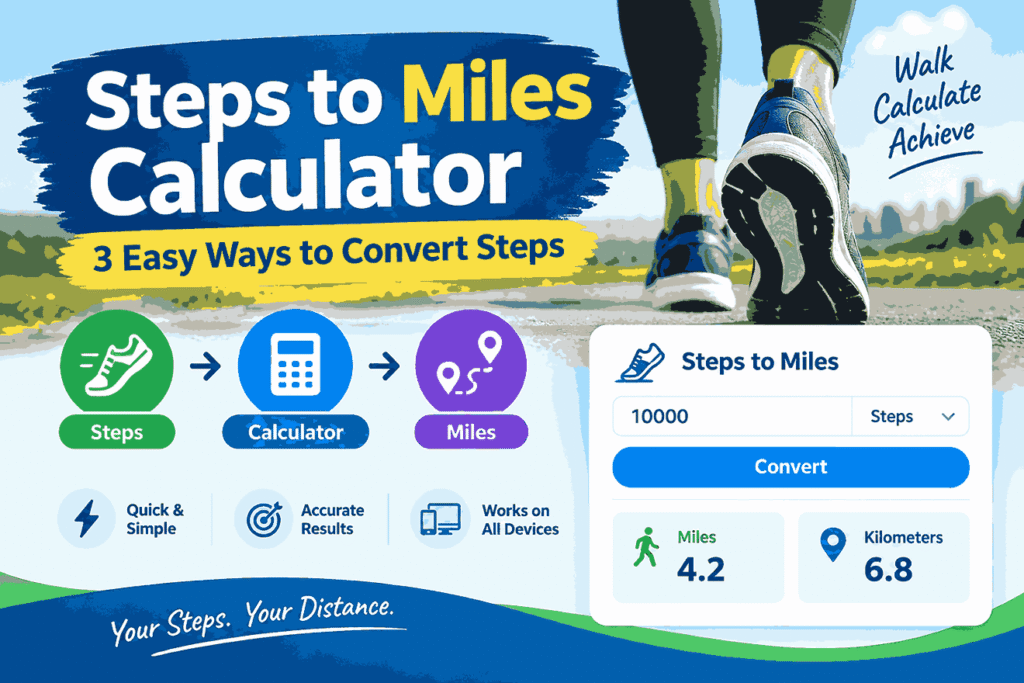
Walking is a simple way to stay active, but a daily step count does not always show how much distance a person has covered. Converting steps into miles helps walkers and runners understand their progress, set realistic fitness goals, and track their activity more effectively. A Steps to Miles Calculator provides a quick estimate using the number of steps taken and, when available, an individual’s stride length. There are also simple formulas and charts that can help estimate distance without a calculator. This guide explores three easy conversion methods, explains the factors that affect accuracy, and shows how step counts can be used to monitor daily walking and running goals.
What Is a Steps to Miles Calculator?
A Steps to Miles Calculator is a tool that estimates the distance covered based on the number of steps taken. It converts a step count into miles using an estimated or personalized stride length.
For example, someone who takes 2,000 steps may cover approximately one mile, depending on stride length and walking style. A person with a longer stride may travel farther with the same number of steps, while someone with a shorter stride may cover less distance.
The tool can be useful for people who track their daily activity with a pedometer, smartwatch, smartphone, or fitness tracker. It can also help walkers compare their progress with weekly goals without measuring every route.
3 Easy Ways to Convert Steps to Miles
There are three practical ways to estimate walking distance: using a calculator, applying a simple formula, or checking a conversion chart. Each method serves a slightly different purpose.
1. Use a Steps to Miles Calculator
The quickest method is to enter the step count into an online calculator. Some calculators also allow users to enter height, stride length, or activity type to provide a more personalized estimate.
The general process is straightforward:
-
Enter the total number of steps recorded.
-
Add stride length or height if the calculator requests it.
-
Select the appropriate measurement units, if available.
-
Calculate the result to estimate the distance in miles.
For instance, a person who records 5,000 steps can use the tool to estimate the distance covered during a morning walk or throughout the day. The result is an estimate rather than an exact measurement unless the actual distance and step length are known.
This method is particularly convenient for people who want a quick answer without performing manual calculations.
2. Calculate the Distance Using a Formula
A formula provides a practical alternative when a calculator is unavailable. The most useful approach is to estimate the distance covered by each step and then convert that distance into miles.
The basic formula is:
There are 5,280 feet in one mile, so the formula divides the total distance in feet by 5,280.
Example:
Suppose a person takes 4,000 steps and has an average stride length of 2.5 feet.
-
Total distance: 4,000 × 2.5 = 10,000 feet
-
Convert feet to miles: 10,000 ÷ 5,280
-
Estimated distance: approximately 1.89 miles
This calculation illustrates how the steps-to-miles conversion works when stride length is known. The result becomes more reliable when the stride measurement reflects the person’s usual walking pattern.
3. Use a Conversion Table or Walking Chart
A conversion table is helpful for people who regularly check their walking progress. Instead of calculating each result, they can look up a common step count and use it as a quick reference.
For general planning, a rough estimate of 2,000 to 2,500 steps per mile is often used. However, actual results vary with stride length, height, pace, and whether the person is walking or running.
A chart is best treated as a guide rather than a precise measurement. Someone who needs a more personalized result can use their measured stride length or a calculator that supports individual measurements.
How Many Steps Are in a Mile?
The number of steps required to cover one mile depends mainly on stride length. A commonly used estimate is around 2,000 steps per mile, although some people may need considerably more or fewer steps to cover the same distance.
The following examples illustrate how step counts can translate into approximate distances.
| Step count | Estimated distance |
|---|---|
| 1,000 steps | 0.5 miles |
| 2,000 steps | 1 mile |
| 3,000 steps | 1.5 miles |
| 5,000 steps | 2.5 miles |
| 8,000 steps | 4 miles |
| 10,000 steps | 5 miles |
| 12,000 steps | 6 miles |
These examples use an approximate conversion of 2,000 steps per mile. Actual distance may differ.
Understanding Steps per Mile
Steps per mile describes the number of steps a person takes to travel one mile. It is influenced by leg length, walking technique, speed, terrain, and individual movement patterns.
A person with a longer stride generally needs fewer steps to cover a mile. Someone with a shorter stride generally takes more steps to travel the same distance.
For a more accurate estimate, the number of steps taken over a measured distance can be recorded. Dividing the total steps by the miles traveled gives a personalized conversion factor that can be used for future estimates.
How Stride Length Affects Distance
Stride length is one of the most important factors in estimating walking distance. In everyday use, it refers to the distance covered by a step or stride, although some technical sources distinguish a single step from a complete two-step stride cycle. For calculator purposes, the measurement must match the definition requested by the tool.
For example, if a calculator asks for the distance covered by each individual step, a person should measure that distance rather than enter the length of a complete left-right walking cycle.
A simple way to estimate individual step length is to walk a known distance, count the steps, and divide the distance by the step count.
The measurement can then be used to estimate future walking distances.
Height-Based Estimates
Height can help provide a starting estimate when actual stride length is unknown. Taller people often have longer steps, while shorter people may have shorter steps, but this relationship is not identical for everyone.
Height-based estimates should therefore be treated as approximations. Two people of the same height may have different walking patterns, leg proportions, or preferred paces.
A calculator that accepts height may provide a useful initial result, but a measured step length will generally offer a more personalized estimate. Repeating the measurement over a known distance can also help account for natural variations in walking style.
Steps to Kilometers: Converting Distance Between Units
Some fitness trackers report distance in kilometers rather than miles. Converting between the two units helps users compare results across devices and fitness programs.
One mile equals approximately 1.609 kilometers, while one kilometer equals approximately 0.621 miles.
The process for converting steps into kilometers is similar to converting steps into miles: first estimate the distance covered, then express that distance in the desired unit.
For example, if a walking session covers 2 miles, the equivalent distance is approximately 3.22 kilometers. A step-based estimate will vary according to the individual’s stride length.
This type of Length conversion is useful when comparing walking records, planning routes, or tracking activity across devices that use different distance units.
Steps to Calories: Can Step Counts Estimate Calories Burned?
Step counts can provide context for physical activity, but they cannot determine calorie expenditure precisely on their own. Calories burned depend on several factors, including body weight, distance, speed, terrain, fitness level, and exercise intensity.
A step-to-calorie estimate typically uses step count alongside other information to approximate energy expenditure. For example, a brisk walk over a longer distance may require more energy than a short, slow walk.
Weight and Calories Burned
Body weight can influence the energy required to move. As a general principle, a heavier person may expend more energy performing the same walking activity than a lighter person, although individual results vary.
A calculator that includes weight and walking pace may provide a more useful estimate than one that relies on steps alone. Even then, the result should be considered an approximation rather than a direct measurement of energy expenditure.
People tracking fitness progress can use calorie estimates as a general reference while focusing on consistent activity levels and realistic personal goals.
Miles to Steps: How to Reverse the Calculation
The conversion can also work in the opposite direction. Someone planning a walk may know the desired distance but want to estimate how many steps it will require.
The Reverse conversion formula is:
For example, if a person averages 2,000 steps per mile, a 3-mile walk would require approximately:
3 × 2,000 = 6,000 steps.
This is the basic principle behind Miles’ two-step calculations. A personalized step count per mile generally produces a better estimate than a universal average.
The same method can be applied when planning a daily walking target, estimating the steps needed to complete a route, or comparing distances across several walks.
Walking and Running Pace: Why the Estimates Differ
Walking and running do not always produce the same distance per step. Running often involves a longer stride, although the exact difference depends on speed, technique, and the individual.
Walking and running pace can therefore affect the relationship between step count and distance. A step count recorded during a brisk walk may produce a different estimate from the same number of steps recorded during a run.
People who switch between walking and running should consider using separate stride measurements for each activity when accuracy matters. A general calculator can still provide a useful estimate, but it may not account for every change in movement.
Walking Steps Chart and Running Steps Chart
Charts make it easier to compare common step counts with estimated distances. They are particularly useful for people who want to set activity targets without calculating every result individually.
Walking Steps Chart
The following Walking steps chart uses a simple estimate of 2,000 steps per mile.
| Steps | Approximate miles |
|---|---|
| 2,000 | 1 mile |
| 4,000 | 2 miles |
| 6,000 | 3 miles |
| 8,000 | 4 miles |
| 10,000 | 5 miles |
| 12,000 | 6 miles |
| 15,000 | 7.5 miles |
| 20,000 | 10 miles |
These figures are useful for general planning, but a personalized estimate may differ because each person has a different step length.
Running Steps Chart
A Running steps chart can use the same calculation method, but the steps-per-mile estimate should reflect running stride length rather than walking stride length.
| Running steps | Example estimated distance |
|---|---|
| 2,000 | 1 mile |
| 4,000 | 2 miles |
| 6,000 | 3 miles |
| 8,000 | 4 miles |
| 10,000 | 5 miles |
This example uses the same illustrative conversion of 2,000 steps per mile as the walking chart. It is not a universal running average. Runners who want a more accurate result should measure their running steps over a known distance.
How to Improve Step-to-Mile Accuracy
A reliable Step-count conversion depends on the quality of the information entered. Several practical steps can improve the estimate.
-
Measure step length: Walking a known distance and counting individual steps provides a personalized starting point.
-
Use consistent conditions: Measurements taken on a flat surface may be easier to compare than those taken across varied terrain.
-
Separate walking and running measurements: Different movement patterns can change the distance covered per step.
-
Check the device: A smartwatch or phone may miss steps or count some movements incorrectly, affecting the final estimate.
-
Update measurements when necessary: Changes in walking technique, footwear, or mobility can affect the results.
The Conversion factor used by a calculator is especially important. A generic factor is convenient for a quick estimate, while a factor calculated from personal measurements is more useful for tracking individual progress over time.
Frequently Asked Questions
1. How many steps equal one mile?
A commonly used estimate is approximately 2,000 steps per mile. The actual number varies depending on step length, height, walking technique, and pace.
2. How can someone convert steps to miles without a calculator?
The simplest approach is to divide the step count by an estimated number of steps per mile. For example, 6,000 steps divided by 2,000 steps per mile equals approximately 3 miles.
3. Is a Steps to Miles Calculator accurate?
It can provide a useful estimate, particularly when the step count and stride length are accurate. A calculator using a general average may be less precise than one using individual measurements.
4. Does height affect the distance covered by each step?
Height can influence step length, but it does not determine it completely. Leg proportions, walking style, and speed also affect the distance covered.
5. How many steps are needed to walk 5 miles?
Using the approximate rate of 2,000 steps per mile, a 5-mile walk would involve around 10,000 steps. The actual total may be higher or lower depending on stride length.
6. Can step counts be used to estimate kilometers?
Yes. A calculator can estimate the distance from steps and express the result in kilometers instead of miles. One mile is approximately 1.609 kilometers.
Conclusion
A Steps to Miles Calculator makes it easier to understand how daily movement translates into distance. Whether someone uses an online tool, applies a formula, or checks a chart, the basic calculation offers a practical way to monitor walking and running activity.
The most suitable method depends on the level of accuracy required. General estimates work well for everyday planning, while personalized stride measurements can provide more useful results for people who track their activity closely. By understanding step length, choosing an appropriate conversion method, and reviewing activity consistently, walkers and runners can make better use of their step counts when setting and monitoring fitness goals.