
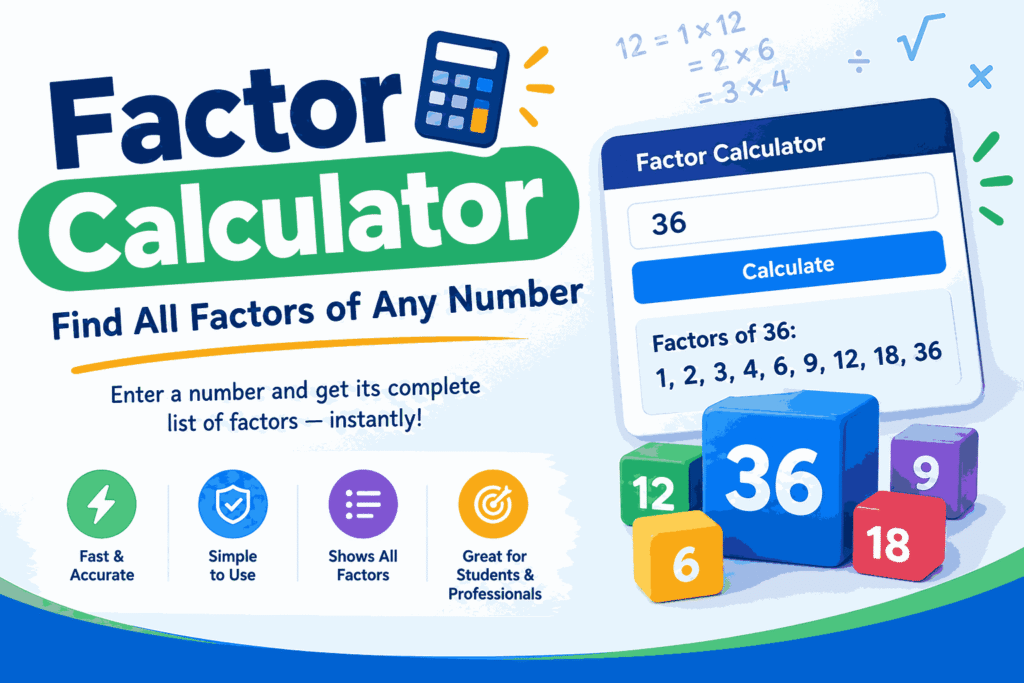
Finding the factors of a number is an important part of mathematics, but checking every possible divisor by hand can take time, especially when working with larger numbers. A factor calculator makes this process easier by identifying the whole numbers that divide a given number without leaving a remainder.
Factors are useful in arithmetic, fractions, multiplication, division, and more advanced topics such as algebra. Understanding how they work can help students solve problems more confidently and recognize number patterns.
This guide explains how a factor calculator works, what factors and factor pairs mean, how to find the factors of a number manually, and how to use practical examples to understand the process.
What Is a Factor Calculator?
A factor calculator is an online mathematical tool that finds the factors of a whole number. It checks which positive integers divide the entered number evenly, producing a list of factors without requiring lengthy manual calculations.
For example, the number 12 has six positive factors: 1, 2, 3, 4, 6, and 12. Each of these numbers divides 12 without leaving a remainder.
A factor calculator can be useful for:
-
Finding all positive factors of a number.
-
Identifying factor pairs that multiply to produce the original number.
-
Checking whether a number is prime or composite.
-
Solving school mathematics and homework problems.
-
Understanding divisibility and multiplication relationships.
-
Checking calculations before working through more complicated problems.
The main advantage is convenience. Instead of testing every possible divisor and recording the results, the calculator can provide an organized answer in seconds.
What Are Factors in Mathematics?
A factor is a whole number that divides another whole number exactly, leaving no remainder.
For example, 20 can be divided evenly by 1, 2, 4, 5, 10, and 20. Therefore, all six numbers are positive factors of 20.
The relationship can also be explained through multiplication:
-
\(1 \times 20 = 20\)
-
\(2 \times 10 = 20\)
-
\(4 \times 5 = 20\)
Each multiplication equation demonstrates two factors of 20.
Factors are different from multiples. A factor divides a number evenly, while a multiple is produced by multiplying a number by an integer. For instance, 5 is a factor of 20, whereas 25 is a multiple of 5.
Understanding this distinction makes it easier to solve problems involving division, fractions, and number patterns.
How to Use a Factor Calculator
A factor calculator is generally straightforward to use. Although individual tools may have different layouts, the basic process remains similar.
-
Enter a number. Type a positive whole number into the calculator’s input field.
-
Run the calculation. Select the calculate button to begin checking the possible divisors.
-
Review the results. The tool displays the factors that divide the entered number without a remainder.
-
Check the factor pairs. If the calculator supports this feature, review the pairs that multiply to give the original number.
-
Use the answer. Apply the results to homework, arithmetic exercises, or other mathematical calculations.
For example, entering 36 produces the positive factors 1, 2, 3, 4, 6, 9, 12, 18, and 36. These values can then be checked by multiplying factor pairs or dividing 36 by each factor.
The calculator reduces repetitive work, while understanding the results helps build stronger mathematical skills.
How to Find All Factors of a Number Manually
A factor calculator can provide a quick answer, but the same process can also be completed by hand. The method involves testing which whole numbers divide the given number evenly.
Consider 24 as an example.
-
Start with 1, which divides every positive whole number evenly.
-
Test 2. Since \(24 \div 2 = 12\), both 2 and 12 are factors.
-
Test 3. Since \(24 \div 3 = 8\), both 3 and 8 are factors.
-
Test 4. Since \(24 \div 4 = 6\), both 4 and 6 are factors.
-
Continue testing possible divisors until no new factor pairs remain.
The complete list of positive factors of 24 is:
There is no need to test every number all the way to 24. Once a divisor becomes larger than the square root of the original number, its corresponding factor will already have been found.
For 24, the square root is approximately 4.9. Testing whole numbers up to 4 is enough to identify the factor pairs.
This method is especially helpful for larger numbers because it reduces the number of calculations required.
Understanding Factor Pairs
Factor pairs are two whole numbers that multiply to produce a particular number. They provide another way to organize and verify the factors of a number.
For example, the factor pairs of 30 are:
| Factor | Pair factor | Product |
|---|---|---|
| 1 | 30 | 30 |
| 2 | 15 | 30 |
| 3 | 10 | 30 |
| 5 | 6 | 30 |
Each pair produces 30 when multiplied together. Combining the numbers from all four pairs gives the complete set of positive factors: 1, 2, 3, 5, 6, 10, 15, and 30.
Factor pairs are useful when simplifying fractions, arranging objects into equal groups, and identifying numbers that divide evenly into a total.
A calculator that displays both factors and their pairs can make these relationships easier to understand.
Prime Numbers vs. Composite Numbers
Factors can also help distinguish between prime and composite numbers.
What Is a Prime Number?
A prime number is a whole number greater than 1 that has exactly two positive factors: 1 and itself.
Examples include:
-
2, with factors 1 and 2.
-
3, with factors 1 and 3.
-
7, with factors 1 and 7.
-
13, with factors 1 and 13.
-
17, with factors 1 and 17.
The number 2 is the only even prime number. Every other even whole number greater than 2 is divisible by 2 and therefore has more than two positive factors.
What Is a Composite Number?
A composite number is a whole number greater than 1 that has more than two positive factors.
For example, 18 has the factors 1, 2, 3, 6, 9, and 18. Because it has six positive factors, it is composite.
Similarly, 25 has the factors 1, 5, and 25, making it composite.
The number 1 is neither prime nor composite because it has only one positive factor.
A factor calculator can help identify these categories by displaying the complete factor list. A number with exactly two positive factors is prime, while a number with more than two is composite.
Examples of Finding Factors
Working through examples demonstrates how the same principles apply to different numbers.
Example 1: Factors of 16
The number 16 can be divided evenly by 1, 2, 4, 8, and 16.
Its positive factors are:
The factor pairs are (1, 16), (2, 8), and (4, 4). Since 16 has more than two positive factors, it is a composite number.
Example 2: Factors of 21
The number 21 is divisible by 1, 3, 7, and 21.
Its positive factors are:
The factor pairs are (1, 21) and (3, 7). Since 21 has four positive factors, it is composite.
Example 3: Factors of 29
The number 29 is divisible by 1 and 29, with no other positive whole-number divisors.
Its positive factors are:
Because it has exactly two positive factors, 29 is prime.
These examples show how factor lists can reveal useful information about a number’s structure, even when the numbers themselves are relatively small.
How Does a Factor Calculator Work?
A factor calculator uses divisibility checks to identify the whole numbers that divide the input evenly.
One basic approach is to test candidate divisors starting at 1. If dividing the original number by a candidate produces a remainder of zero, that candidate is a factor.
For example, when checking whether 15 is divisible by 4:
Because the result is not a whole number, 4 is not a factor of 15.
By contrast:
Since the division has no remainder, 3 is a factor of 15. Its corresponding factor, 5, is also identified.
More efficient algorithms use the square root of the input number to limit the number of divisibility checks. Whenever a factor is found, the calculator can also identify its matching factor.
This approach helps produce results quickly without checking every integer up to the original number.
Positive and Negative Factors
Many basic factor calculators display only positive factors, but negative integers can also be factors of a number.
For example, the positive factors of 12 are 1, 2, 3, 4, 6, and 12. Its negative factors are −1, −2, −3, −4, −6, and −12.
Negative factors work because multiplying two negative numbers produces a positive result. For instance:
When a mathematics problem asks for all integer factors, both positive and negative factors may be required. When it asks for positive factors, only the positive values should be listed.
The distinction is important when solving algebra problems or working with integers. Checking the calculator’s output settings can help ensure that the results match the requirements of the problem.
Why Use an Online Factor Calculator?
An online tool can make routine mathematical tasks faster and easier to verify. Its usefulness extends beyond simply producing a list of numbers.
Saves time: Larger numbers may have many factors, making manual calculations repetitive. Automated divisibility checks reduce that effort.
Reduces calculation errors: A calculator helps avoid overlooking factors or recording an incorrect factor pair, although results should still be checked when accuracy is important.
Supports learning: Comparing calculator results with manual calculations can help students understand divisibility, prime numbers, and multiplication relationships.
Helps with homework: The results can be used to verify answers and identify mistakes in factorization exercises.
Makes number patterns easier to recognize: Reviewing factor lists helps demonstrate why some numbers have only two positive factors while others have many.
For the best learning experience, the calculator works most effectively alongside an understanding of the mathematical principles behind its results.
Frequently Asked Questions
1. What does a factor calculator do?
A factor calculator identifies the whole numbers that divide a given number evenly. Depending on the tool, it may also display factor pairs and help determine whether the number is prime or composite.
2. How can all factors of a number be found?
The factors can be found by testing positive whole numbers that divide the original number without a remainder. Checking divisors up to the square root of the number can make the process more efficient.
3. Is 1 a factor of every whole number?
Yes. Every positive whole number is divisible by 1 without a remainder. The number 1 itself has only one positive factor: 1.
4. What is the difference between factors and multiples?
Factors divide a number evenly, while multiples are obtained by multiplying a number by an integer. For example, 4 is a factor of 20, whereas 20 and 40 are multiples of 4.
5. Can a factor calculator identify prime numbers?
Yes. If a number greater than 1 has exactly two positive factors, it is prime. If it has more than two, it is composite.
6. Can factors be negative?
Yes. Negative integers can be factors because the product of two negative numbers is positive. However, many calculators display positive factors by default, so the required type of factor should be checked.
Conclusion
Finding factors is a fundamental mathematical skill that supports work with fractions, divisibility, multiplication, and prime numbers. Although the process can be completed manually, testing every possible divisor may become repetitive when working with larger numbers.
A factor calculator simplifies the task by identifying the positive factors of a number and, when supported, displaying factor pairs and other useful results. Understanding how the calculations work also helps users verify answers rather than relying entirely on an automated result.
By combining an online tool with basic mathematical knowledge, students and other learners can solve factor-related problems more efficiently and build a clearer understanding of how numbers relate to one another.