

Planning a landscaping, driveway, walkway, or construction project often involves figuring out how much rock will be needed. Ordering too much can increase costs and leave excess material, while ordering too little may result in delays and another delivery. A rock calculator can make this estimation process much easier by using the project’s measurements to determine the approximate amount of material required.
This guide explains how rock quantities are calculated, what measurements are needed, and how the results can help with better project planning.
What Is a Rock Calculator?
A rock calculator is a tool designed to estimate the quantity of rock or aggregate required to cover a specific area. It generally uses measurements such as length, width, and depth to calculate the project’s volume.
Depending on the type of calculator, the result may be displayed in cubic feet, cubic yards, tons, or another measurement commonly used when purchasing landscaping or construction materials.
The basic purpose is simple: it gives a project owner a practical estimate before materials are ordered.
Why Accurate Rock Estimates Matter
Accurate material estimates can make a noticeable difference in project planning. Rock is often purchased in relatively large quantities, so even a small calculation error can affect the final cost.
A reliable estimate can help:
-
Reduce unnecessary material purchases
-
Avoid running short during installation
-
Improve project budgeting
-
Make delivery planning easier
-
Reduce leftover material and waste
-
Give contractors and homeowners a clearer idea of project requirements
An estimate is not necessarily an exact prediction because rock density, size, shape, and supplier measurements can vary. However, a careful calculation provides a useful starting point.
How Rock Quantity Is Calculated
The calculation usually begins by finding the volume of the area that needs to be covered.
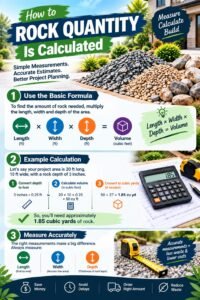
For a simple rectangular area, the basic formula is:
Length × Width × Depth = Volume
For example, a project measuring 20 feet long and 10 feet wide with a rock depth of 3 inches first requires the depth to be converted into feet.
Three inches equals 0.25 feet.
The calculation would therefore be:
20 × 10 × 0.25 = 50 cubic feet
If the material is purchased by cubic yard, the cubic-foot result can be converted by dividing it by 27:
50 ÷ 27 ≈ 1.85 cubic yards
This provides an approximate material requirement before accounting for other project considerations.
What Measurements Are Needed?
Getting accurate measurements is one of the most important parts of the process. Most basic calculations require three measurements.
Length
The length represents the distance from one end of the project area to the other. It should be measured using the same unit throughout the calculation.
Width
The width measures the distance across the area. For irregular spaces, the area may need to be divided into smaller sections before the calculations are combined.
Depth
Depth indicates how thick the rock layer will be. It is particularly important because even a small change in depth can significantly affect the total quantity of material required.
If the desired depth is provided in inches while the other measurements are in feet, the depth should be converted before completing the calculation.
Estimating Rock for Irregular Areas
Not every project has a simple rectangular shape. Gardens, pathways, driveways, and other outdoor spaces may contain curves, corners, or multiple sections.
In these situations, the area can be divided into smaller, easier-to-measure shapes. Each section can then be calculated separately, with the individual results added together.
For example, a larger project could be divided into rectangles and triangles. Calculating each section independently can make the overall estimate more manageable and reduce the chance of overlooking part of the area.
Accounting for Extra Material
A calculated quantity does not always represent the exact amount that should be ordered. Small variations can occur during transportation, spreading, installation, and measurement.
For that reason, some projects may benefit from ordering a modest amount of additional material. The appropriate allowance depends on the project’s shape, rock type, installation method, and the accuracy of the measurements.
Too much additional material, however, can defeat the purpose of careful estimation. A reasonable allowance is generally more practical than adding a large percentage without considering the project’s circumstances.
Different Types of Rock Require Different Considerations
Rock is available in many forms, including crushed stone, gravel, river rock, decorative stone, and other aggregates. These materials can differ in size, density, and how efficiently they fill a space.
Two materials occupying the same volume may not necessarily have the same weight. This is why volume and weight should not be treated as interchangeable measurements.
When purchasing material by weight, the supplier’s information about the material’s approximate weight per cubic yard or cubic foot can help convert a volume estimate into a weight estimate.
Common Mistakes to Avoid
Several simple mistakes can make a rock estimate less accurate.
Using the Wrong Units
Mixing inches, feet, and yards without converting them can produce a significantly incorrect result. All measurements should be converted into compatible units before the calculation is completed.
Forgetting Depth
Calculating only length and width provides the surface area, not the quantity of rock required. The planned depth must also be included.
Measuring Irregular Areas as One Shape
Trying to force an irregular space into a simple rectangle can overestimate or underestimate the actual requirement. Dividing the space into smaller sections is usually more reliable.
Ignoring Material Differences
Different rock products can have different densities and characteristics. A volume estimate should therefore be matched with the specific material being purchased.
How a Rock Calculator Helps With Project Planning
The main benefit of a rock calculator is convenience. Instead of repeatedly working through measurements and conversions by hand, a calculator can provide a quick estimate based on the information entered.
It can also help homeowners compare project options. For example, changing the planned depth can show how the material requirement changes. This can be useful when balancing the desired appearance with the available budget.
For contractors, a clear material estimate can also make ordering and delivery planning more straightforward.
Final Thoughts
Estimating rock does not have to be complicated. With accurate measurements, consistent units, and an appropriate calculation method, homeowners and contractors can develop a useful estimate before purchasing materials.
A rock calculator provides a convenient way to simplify that process. While the final quantity may still vary because of material characteristics and project conditions, a well-prepared estimate can help reduce waste, control costs, and make the overall project easier to manage.