

Understanding partnership income can become confusing when a business has multiple partners, different sources of income, and various expenses. Knowing how to calculate total partnership income helps provide a clearer picture of the money a partnership earns during a specific period. The process generally involves identifying the partnership’s total income, accounting for allowable business expenses, and determining the resulting income.
This guide explains the basic calculation process in simple terms. It also looks at the information needed, provides an easy example, and discusses some common mistakes that can make partnership income calculations less clear.
What Is Partnership Income?
Partnership income is the income generated by a business that is owned and operated by two or more partners. Unlike a business owned by a single individual, a partnership involves multiple people who share responsibility for the business according to their partnership agreement.
The income may come from the partnership’s normal business activities, such as selling products or providing services. Depending on the type of business, there may also be other sources of income.
The total amount earned does not necessarily represent the partnership’s final income. Business expenses and other relevant deductions may need to be considered before determining the income available for allocation between the partners.
What Information Is Needed?
Before starting the calculation, it is helpful to gather the partnership’s financial records for the relevant period. Accurate records make the process easier and reduce the possibility of overlooking an important figure.
The main information may include:
- Total business revenue
- Other business income
- Cost of goods sold, where applicable
- Operating expenses
- Employee wages
- Rent and utilities
- Business-related professional fees
- Other allowable business expenses
- The partners’ agreed profit-sharing percentages
The exact items included can vary depending on the partnership’s activities and the accounting or tax rules that apply.
How to Calculate Total Partnership Income
A straightforward approach starts with the partnership’s total income and then subtracts the relevant business expenses.
A simplified formula can be written as:
Total Partnership Income = Total Business Income − Allowable Business Expenses
For example, suppose a partnership earns $120,000 from its business activities during a year. It also receives $5,000 from another business-related source. The partnership therefore has $125,000 in total income.
If its allowable business expenses amount to $45,000, the calculation would be:
$125,000 − $45,000 = $80,000
In this simplified example, the partnership income would be $80,000 before considering any additional rules or adjustments that may apply.
Step 1: Determine Total Business Income
The first step is to identify all relevant income earned by the partnership during the accounting period.
For a service-based business, this could include payments received from customers or clients. For a retail business, it may primarily consist of sales revenue.
All relevant income sources should be reviewed rather than relying on a single revenue figure. Bank statements, invoices, accounting software, sales records, and other financial documents can help establish the correct amount.
Keeping these records organized throughout the year can make the calculation much easier.
Step 2: Add Other Relevant Income
A partnership may receive income in addition to its primary business revenue.
For example, the business could have income from interest, certain investments, asset sales, or another activity connected with the partnership. Whether a particular amount should be included depends on its nature and the applicable accounting or tax rules.
For that reason, each additional income source should be identified and classified correctly rather than automatically added to the business revenue.
Step 3: Identify Business Expenses
After determining the income, the next step is to review the partnership’s business expenses.
Common expenses can include:
- Office or commercial rent
- Utilities
- Employee wages
- Advertising
- Insurance
- Accounting services
- Legal services
- Business software
- Supplies
- Repairs and maintenance
- Other ordinary business costs
The partnership should maintain supporting records for these expenses. Receipts, invoices, contracts, and transaction records can help demonstrate where the amounts came from.
Not every payment made by a partnership is necessarily an allowable business expense. Personal spending and other non-business items may need to be treated separately.
Step 4: Subtract Applicable Expenses
Once the relevant expenses have been identified, they can be deducted from the partnership’s income according to the applicable accounting method and rules.
For example:
Total Income: $200,000
Business Expenses: $70,000
Partnership Income: $200,000 − $70,000 = $130,000
The resulting figure represents the partnership income in this simplified example.
Actual calculations can be more complicated because certain expenses may have special treatment, and some accounting or tax adjustments may apply.
Step 5: Determine Each Partner’s Share
After the partnership income has been determined, the amount may need to be allocated among the partners.
The allocation is generally based on the partnership agreement and the applicable rules.
For example, imagine that a partnership has two partners and the agreement provides for an equal division of profits. If the partnership income is $100,000, each partner’s share would be:
$100,000 × 50% = $50,000
If the partners have different profit-sharing percentages, the allocation would change accordingly.
For instance, if one partner receives 60% and another receives 40%:
$100,000 × 60% = $60,000
$100,000 × 40% = $40,000
The total of the allocated shares should correspond to the partnership income being distributed or reported under the applicable rules.
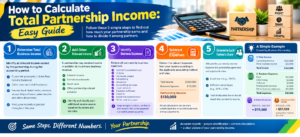
A Simple Example
Consider a small partnership that operates a consulting business.
During the year, the business earns:
- Consulting revenue: $150,000
- Other business income: $10,000
The total income is therefore:
$150,000 + $10,000 = $160,000
The partnership then has business expenses of:
- Rent: $15,000
- Advertising: $8,000
- Software: $5,000
- Professional services: $7,000
- Other business expenses: $10,000
Total expenses are:
$15,000 + $8,000 + $5,000 + $7,000 + $10,000 = $45,000
The simplified partnership income calculation becomes:
$160,000 − $45,000 = $115,000
If the partners share profits equally, each partner’s share would be:
$115,000 × 50% = $57,500
This example demonstrates the basic process without accounting for special tax treatments or other adjustments that may apply in a real partnership.
Common Mistakes to Avoid
Several mistakes can make partnership income calculations inaccurate.
Mixing Personal and Business Expenses
Personal expenses should not automatically be treated as partnership expenses. Keeping business and personal transactions separate makes financial records easier to review.
Forgetting Additional Income
Focusing only on sales or service revenue can result in other relevant income being overlooked. All appropriate income sources should be reviewed.
Using Incorrect Profit-Sharing Percentages
The partners’ shares should be based on the applicable partnership agreement and rules. Assuming that profits are always divided equally can lead to an incorrect allocation.
Ignoring Supporting Records
A calculation is much easier to verify when income and expenses are supported by invoices, receipts, bank records, and other documentation.
Confusing Income With Cash Available
Partnership income and the amount of cash currently held by the business are not necessarily the same thing. Accounting adjustments, unpaid amounts, asset purchases, loans, and other transactions can affect cash without directly representing partnership income.
Why Accurate Calculation Matters
Accurate partnership income calculations help partners understand how the business performed during a particular period. They can also provide useful information for financial planning, bookkeeping, reporting, and discussions between partners.
Clear records can make it easier to identify changes in revenue and expenses from one period to another. They can also help partners understand how the business’s financial results relate to their agreed profit-sharing arrangements.
Because partnership and tax rules can differ depending on the jurisdiction and circumstances, professional accounting or tax advice may be appropriate when the calculation is being used for an official filing or financial decision.
Final Thoughts
Learning how to calculate total partnership income becomes easier when the process is broken into clear steps. The basic approach is to identify the relevant income, account for applicable business expenses, determine the resulting partnership income, and then apply the appropriate profit-sharing arrangement.
A simple formula can provide a useful starting point:
Total Partnership Income = Total Business Income − Allowable Business Expenses
Real-world partnerships may require additional calculations and adjustments, so accurate records and appropriate professional guidance can be important. Still, understanding the basic method gives partners a clearer foundation for reviewing their business income and financial records.